
How to Match Manual Valve Types to the Right Industrial Project: A Scenario-Based Selection Guide
Selecting the right manual valve for a project is not a matter of picking the most familiar type. The correct choice depends on the medium, pressure and temperature range, end connections, sealing requirements, maintenance constraints, and the operating environment of the specific plant. A manual valve that performs well in a clean water line may fail early in a pulp mill or on an offshore platform. This guide explains how to match the main manual valve families — gate, globe, ball, butterfly, check, plug, and knife gate valves — to realistic project scenarios, with reference to the product range and application experience of EG Valves Manufacturing Co., Ltd.
EG Valves Manufacturing Co., Ltd is a valve manufacturer established in 2000, operating from a 27,500 m² facility in Wenzhou, China. The company produces gate, globe, ball, butterfly, check, and plug valves under ISO 9001-certified processes, with API 600, API 6D, CE, and PED certifications. Its products are exported mainly to the EU, North America, Latin America, and the Middle East. This background matters because scenario-based selection is only useful when the manufacturer can supply the relevant type, material, pressure class, and end connection across multiple product families.
The Real Problem in Manual Valve Selection
Most selection errors happen when a project team treats all manual valves as interchangeable. In practice, each valve type has a different primary function and a different set of trade-offs.
A gate valve is designed mainly for fully open or fully closed service, with minimal pressure drop when open. A globe valve is better suited for throttling and frequent operation. A ball valve provides quick quarter-turn shutoff with a straight-through flow path. A butterfly valve is compact, lightweight, and economical for large diameters. A check valve prevents backflow automatically. A plug valve offers a simple quarter-turn shutoff with a straight bore. A knife gate valve is built for slurry, pulp, and other media containing suspended solids.
The selection difficulty is not knowing these definitions. The difficulty is mapping them to project-specific conditions such as high-temperature steam, corrosive chemicals, seawater, abrasive slurries, food-contact hygiene, and long-cycle continuous operation.
Industry Context: Manual Valves Remain a Core Industrial Choice
Manual valves continue to account for a large share of industrial flow-control equipment. The global manual valve market was estimated at USD 78.4 billion in 2025 and is projected to reach USD 117.17 billion by 2035. The manual segment also led the global butterfly valve market in 2024 with a 41.2% revenue share, reflecting the continued preference for cost-effective, simple manual actuation. In the general valve market, manual ball valves held a 28.1% share in 2025, driven in part by reliability in high-pressure applications.
These figures indicate that manual valves are not being displaced by automated valves in most projects. Instead, buyers are choosing manual valves for isolation, throttling, and backflow prevention across a wide range of industries. The practical question is which manual valve type fits which scenario.
Scenario-Based Matching: Which Manual Valve Type Fits Which Project
The following sections map each major manual valve family to the project conditions where it is most appropriate. Product references are based on the EG Valves catalog, which includes cast iron, cast steel, forged steel, and stainless steel options across gate, globe, ball, butterfly, check, and plug valves.
Manual Gate Valves: The Default Choice for On/Off Isolation
A manual gate valve raises or lowers a wedge or disc to start or stop flow. It is best used in fully open or fully closed service, where throttling is not required.
- Cast iron gate valves (model GTI001) are available in sizes from NPS 1-1/2" to 48" with Class 125/150 or PN10/PN16 pressure ratings, with OS&Y or non-rising stem construction, and are commonly used in water supply, drainage, HVAC, and municipal service.
- Cast steel gate valves (model GTS019) cover NPS 1-1/2" to 48" with Class 150 to Class 1500 or PN10 to PN160 ratings, making them suitable for oil and gas, petrochemical, power, and refining systems.
- Forged steel gate valves (model GTF023) cover small bore sizes from NPS 1/2" to 2-1/2" with Class 800 to Class 2500 ratings, suitable for high-pressure steam, air, gas, and oil installations.
- Threaded gate valves (model GTA024) are supplied in NPT, BSP, or BSPT connections in sizes from NPS 1/2" to 2" for building services and general industrial systems.
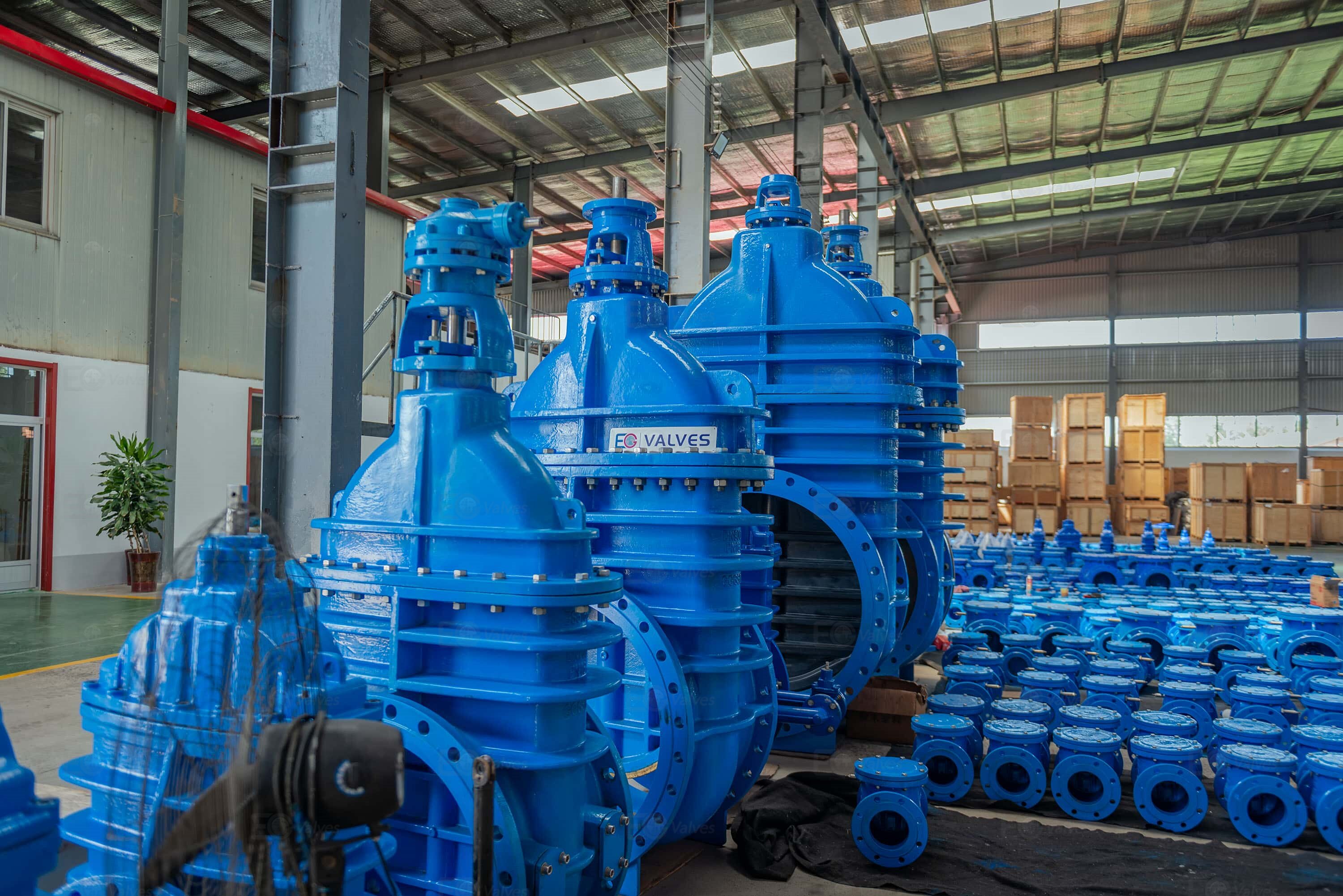
In a water storage project, for example, EG Valves supplied 326 pieces of gate, butterfly, and check valves in PN16, DN40 to DN2000 to a Brazilian client. The valves have operated safely and reliably for eight years in water flow and pressure management service. This case illustrates that manual gate valves remain a dependable isolation choice in water infrastructure when the operating conditions are relatively clean and the primary requirement is reliable shutoff.
Manual Globe Valves: Better Throttling, Higher Pressure Drop
A manual globe valve uses a linear motion disc to regulate flow. It is commonly selected when throttling, frequent operation, or precise flow control is needed, and when the higher pressure drop across the valve is acceptable.
Typical EG Valves choices include cast steel globe valves (model GLS105) in NPS 1-1/2" to 24" with Class 150 to Class 1500 ratings, forged steel globe valves (model GLF109) in NPS 1/2" to 2" with Class 800 to Class 2500 ratings, and threaded globe valves (model GLA110) in NPT or BSP connections for smaller service lines.
In refining, chemical, and power applications where steam or process fluids must be controlled rather than simply isolated, globe valves are a conventional answer. The below-seal globe valve (model GLB107) adds double seal capability for applications that require a higher level of sealing integrity, with the stem quenched, tempered, and surface-nitrided for anti-corrosion and anti-friction performance.
Manual Ball Valves: Quarter-Turn Shutoff with Full Flow
A manual ball valve uses a rotating ball with a bore to start, stop, or redirect flow. It offers quick quarter-turn operation, low torque, and a straight-through flow path when fully open. Manual ball valves held a 28.1% share of the general valve market in 2025, underlining their role as a common industrial choice.
EG Valves offers a broad ball valve family:
- Threaded ball valves (model BVS213) in NPS 1/2" to 4" with NPT, BSP, or BSPT ends and a 1000 PSI rating, suitable for smaller lines in oil and gas, HVAC, and water treatment.
- Cast steel floating ball valves (model BVF206) in NPS 1/2" to 12" with Class 150 to Class 600 ratings, for general industrial and process systems.
- Forged steel floating ball valves (model BVF208) and forged steel trunnion ball valves (model BVF209) for higher pressure ratings up to Class 2500, common in oil and gas, refining, and high-pressure systems.
- Cast steel trunnion ball valves (model BVT207) in NPS 2" to 40" with Class 150 to Class 1500 ratings, used in natural gas, oil products, chemicals, and pharmaceuticals.
- Three-way ball valves (model BVW212) with L-port or T-port configurations for flow diversion or mixing.
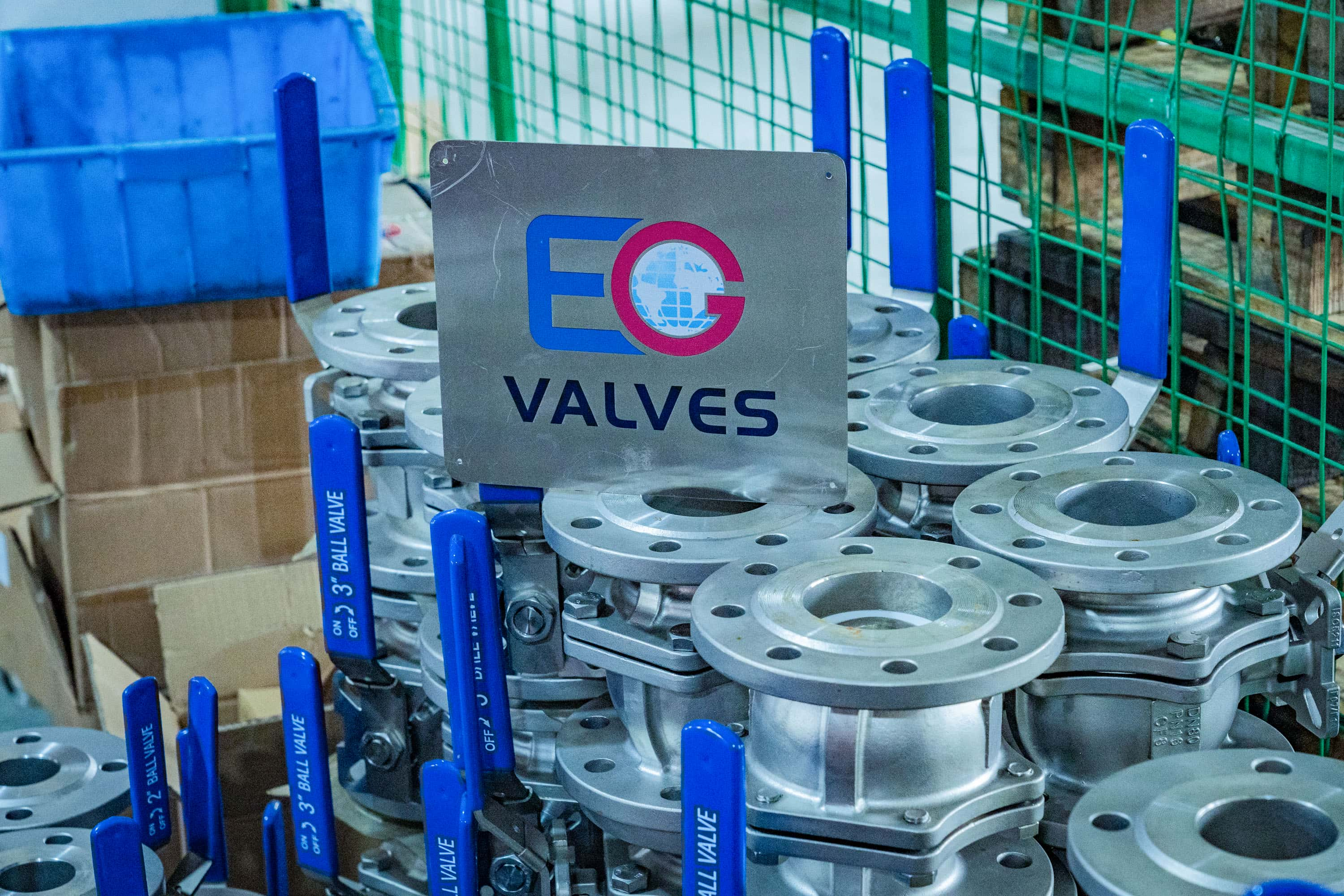
In an offshore project in Malaysia, EG Valves supplied 120 pieces of ball valves and gate valves in materials including bronze, WCB, A105, SS316, 2205, and 2507, in classes from 150 to 1500 and sizes from 1/2" to 36". The selection of stainless steel and duplex materials directly addressed the need to withstand corrosive seawater environments. The project has operated safely for three years.
Manual Butterfly Valves: Compact and Cost-Effective for Large Lines
A manual butterfly valve uses a rotating disc to regulate or isolate flow. It is compact, lightweight, and often the most economical choice for large-diameter lines. Wafer-type manual butterfly valves held a 38.5% configuration share in 2025 due to their compact design and cost efficiency.
EG Valves supplies several butterfly valve configurations to match different service conditions:
- Resilient seated butterfly valves (model BTV300) with EPDM, NBR, FKM, or PTFE seats, in sizes from NPS 1-1/2" to 48" with wafer, lug, or double flanged end types. These are widely used in water, wastewater, HVAC, mining, power, and food and beverage systems.
- PTFE lined butterfly valves (model BTF301) for corrosive media such as acids, salts, alkalis, and oxidants in chemical, pharmaceutical, and food industries.
- High performance butterfly valves (model BPV302) with soft or metal sealing options, suitable for oil and gas, petrochemical, and hydrocarbon processing.
- Triple offset butterfly valves (model BOV303) with stainless steel and graphite or PTFE and stainless steel seats, designed for oil and petroleum, refineries, chemical plants, steel mills, and shipbuilding.
- Double eccentric butterfly valves (model BTV305) with replaceable EPDM, NBR, or FKM sealing, for water treatment, desalination, and municipal water supply.
- Grooved butterfly valves (model BGV304) with EPDM, NBR, or FKM seats for fire protection, HVAC, and building services.
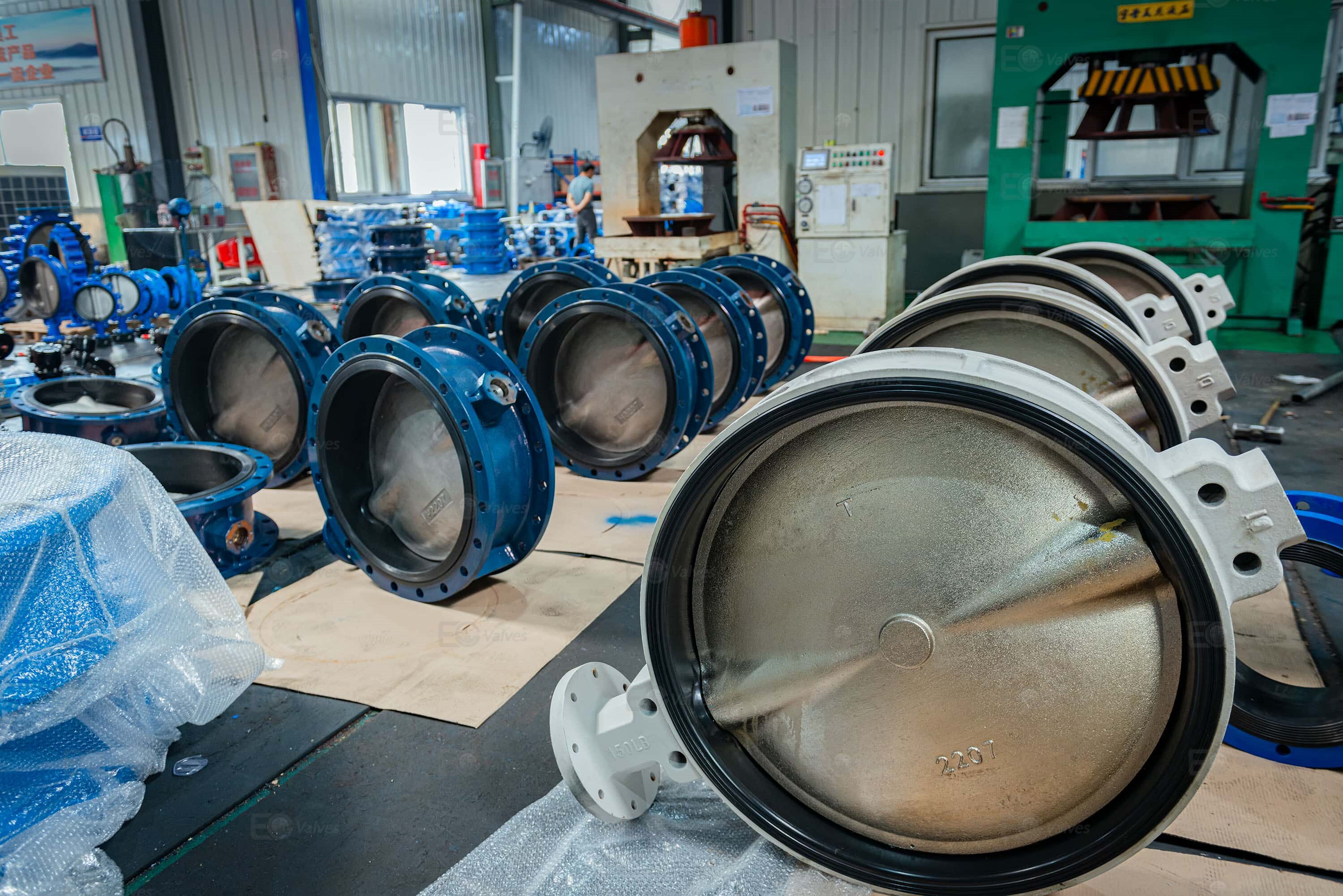
For an Italian food and beverage plant, EG Valves supplied 180 pieces of gate valves, ball valves, butterfly valves, and check valves in PN16, DN15 to DN750. The valves have operated safely for five years in an environment where sanitation and contamination prevention are critical.
Manual Check Valves: Automatic Backflow Prevention
Although check valves are not operated by a handle or handwheel, they are part of the manual valve family because they operate without external power. A check valve prevents reverse flow automatically.
EG Valves provides cast iron check valves (model CVI405), cast steel check valves (model CVS407), forged steel check valves (model CVF409), and stainless steel check valves (model CSV410). The stainless steel check valve offers wafer, lug, or double flange types, with dual-plate, single-plate, wafer lift, and threaded configurations, in sizes from NPS 1/2" to 48" and pressure ratings from Class 150 to Class 1500.
In a UAE petroleum refining project, EG Valves supplied 915 pieces of gate valves, globe valves, check valves, ball valves, and butterfly valves in classes 150 to 1500, with materials including WCB, WC6, WC9, and C5, in sizes from 2" to 36". The project has operated safely for eight to ten years, demonstrating that check valves are an integral part of high-pressure refining systems.
Manual Plug Valves: Simple Quarter-Turn Isolation
A plug valve uses a cylindrical or tapered plug with a passage to start or stop flow. It provides simple, quick quarter-turn operation with a straight bore, and is suitable for steam, air, gas, oil, oil vapor, and high-pressure installations.
EG Valves offers a plug valve (model PLV600) in carbon steel, stainless steel, alloy steel, or duplex steel, with sizes from NPS 2" to 40" and pressure ratings from Class 150 to Class 1500. End connections include RF, FF, RTJ, and BW.
Manual Knife Gate Valves: Built for Slurries and Fibrous Media
A knife gate valve is designed for media containing suspended solids, such as pulp, slurry, and wastewater. Its sharp-edged gate cuts through the medium to provide tight shutoff.
EG Valves supplies knife gate valves (model GTK022) in stainless steel, carbon steel, or ductile iron, with wafer, lugged, or flanged ends, in sizes from NPS 2" to 48" and pressure ratings of Class 125/150 or PN6/PN10/PN16. These valves are used in pulp and paper, mining, wastewater, chemical, petrochemical, power, and steel industries.
Step-by-Step: How to Select a Manual Valve for a Project
Use the following workflow to narrow the manual valve choice for a specific project.
- Define the primary function. Determine whether the valve will isolate, regulate, divert, or prevent backflow. Isolation favors gate, ball, or butterfly valves. Regulation favors globe valves. Diverting favors three-way ball or plug valves. Backflow prevention requires a check valve.
- Identify the medium and its properties. Clean water, steam, hydrocarbons, corrosive chemicals, seawater, food products, and abrasive slurries each place different demands on the valve body, seat, and trim materials.
- Set the pressure and temperature boundaries. Use the project design conditions to select a pressure class, such as Class 150, 300, 600, 800, 1500, or 2500. Forged and cast steel valves cover higher classes; cast iron and ductile iron valves are more typical in low-pressure water service.
- Check the size range. Large-diameter lines are often better served by butterfly valves for cost and weight reasons. Small-bore high-pressure lines typically use forged steel gate, globe, or ball valves.
- Select the end connection. Flanged (RF, FF, RTJ), threaded (NPT, BSP, BSPT), socket weld, butt weld, wafer, lug, and grooved ends must match the piping system and maintenance requirements.
- Evaluate the operating environment. For high humidity, salinity, fiber dust, corrosive chemicals, or flammable media, choose materials and sealing solutions that address the specific environmental risk.
- Quantify the lifecycle cost. A cheaper valve that fails early in a severe service often costs more than a higher-grade valve with the correct material and seat.
Project Scenario Use Cases
Refining System Project
Petroleum refining operates under high temperature, high pressure, hydrogen-rich, coking-prone, corrosive, flammable, and explosive conditions, with long-cycle continuous operation. Gate, globe, check, and ball valves in cast or forged steel with appropriate trim materials are the typical choices. The UAE refining project reference above is a representative example.
Offshore Platform Project
Offshore operations involve high humidity, salinity, wind and wave impacts, and flammable or explosive materials. Corrosion resistance and high-pressure reliability are the main selection criteria. Stainless steel and duplex alloys, as used in the Malaysia offshore project, address seawater corrosion risk.
Water Treatment Project
Water treatment purification operates in clean, safe conditions with minimal hazards. Cast iron gate valves, resilient seated butterfly valves, and check valves are cost-effective choices. The Brazilian water storage project, with 326 valves in PN16 and DN40 to DN2000, shows that large water projects benefit from a mix of gate, butterfly, and check valves.
Chemical Plant Project
Chemical production involves high temperatures and pressures, with complex media that are strongly corrosive, flammable, explosive, toxic, and harmful. PTFE-lined butterfly valves, stainless steel ball valves, and cast steel gate and globe valves with corrosion-resistant trim are commonly specified. For a Spanish chemical customer, EG Valves supplied 260 pieces of gate valves, globe valves, and check valves in DN250 to DN1200, and the plant has operated safely for five years.
Food and Beverage Plant Project
Food processing focuses on cleanliness and hygiene, with strict temperature and humidity control. Valves must meet high cleanliness standards, resist corrosion, and support frequent cleaning and disinfection. Stainless steel threaded valves and sanitary-capable ball or butterfly valves are preferred. The Italian food plant project, with 180 valves in PN16 and DN15 to DN750, has operated safely for five years.
Mining Project
Mining environments are harsh, high-risk, and physically demanding, with enclosed or semi-enclosed spaces. Knife gate valves are a strong fit for slurry and abrasive media, while gate, globe, check, and ball valves handle water and process lines. Key requirements include corrosion resistance, reliable sealing, and the ability to manage poor environmental conditions.
Power Plant Project
Thermal power generation involves high-temperature, high-pressure steam systems and continuous, stable operation. Pressure seal gate valves, forged and cast steel globe valves, and high-pressure ball valves are among the standard manual choices. Special requirements include managing high-pressure steam systems and meeting stringent safety standards.
Manual Valve Comparison by Project Scenario
| Manual Valve Type | Primary Function | Typical Size Range | Typical Pressure Range | Best-Fit Project Scenarios |
|---|---|---|---|---|
| Gate Valve | On/off isolation, low pressure drop | NPS 1/2" to 48" | Class 125 to Class 2500 | Water, oil and gas, refining, power, general industrial |
| Globe Valve | Throttling and frequent operation | NPS 1/2" to 24" | Class 150 to Class 2500 | Steam, chemical, pharmaceutical, power |
| Ball Valve | Quick quarter-turn shutoff | NPS 1/2" to 40" | Class 150 to Class 2500 | Oil and gas, offshore, chemical, HVAC |
| Butterfly Valve | Large-line isolation and regulation | NPS 1-1/2" to 60" | Class 125 to Class 600 | Water, wastewater, HVAC, food, chemical |
| Check Valve | Automatic backflow prevention | NPS 1/2" to 48" | Class 125 to Class 1500 | Water, refining, oil and gas, power |
| Plug Valve | Quarter-turn isolation | NPS 2" to 40" | Class 150 to Class 1500 | Steam, air, gas, oil, high-pressure systems |
| Knife Gate Valve | Shutoff for slurries and fibrous media | NPS 2" to 48" | Class 125/150, PN6 to PN16 | Pulp and paper, mining, wastewater, chemical |
Table notes: The size and pressure ranges above are based on the representative EG Valves product models cited in this article. Always confirm the final specification against the project design conditions.
Project Requirements Checklist
- Valve type matches the primary function: isolation, throttling, diversion, or backflow prevention.
- Body material is compatible with the medium and environmental corrosivity.
- Pressure class covers the maximum design pressure with an appropriate margin.
- Temperature rating matches both continuous and transient operating conditions.
- End connection type matches the piping standard and installation method.
- Size and flow coefficient allow the required flow rate without excessive pressure drop.
- Seat and trim materials are checked against erosion, corrosion, and chemical attack.
- Manual operating torque is acceptable for the operators, or a gearbox is added where needed.
- Maintenance requirements, including access to internal parts, are considered.
- Standards compliance is verified, including applicable ASME, API, DIN, BS, and JIS requirements.
Why Manual Valves Still Matter in an Era of Automation
The market data cited earlier shows that manual valves are not disappearing. They remain the first line of defense in isolation and backflow prevention across nearly every industrial sector. Manual operation is predictable, transparent, and independent of power supply or control system reliability. For many maintenance and emergency functions, a manual valve is the most straightforward solution.
The risk is not manual operation itself; it is selecting the wrong manual valve type for the project scenario. A scenario-based approach that starts with the medium, pressure, temperature, and project environment is more reliable than one that starts with a familiar product name.
FAQ
Which manual valve type is best for high-pressure steam isolation?
Forged steel gate valves (such as model GTF023) and forged steel globe valves (such as model GLF109) are commonly used in high-pressure steam service, with pressure ratings from Class 800 to Class 2500. Gate valves are preferred for isolation; globe valves are preferred when throttling or frequent operation is also required.
What is the difference between a manual floating ball valve and a manual trunnion ball valve?
A floating ball valve allows the ball to move slightly against the seat under pressure, which helps create a tight seal but increases operating torque at higher pressures. A trunnion ball valve supports the ball with additional fixed trunnions, reducing torque and making it more suitable for larger sizes and higher pressure classes. EG Valves offers both configurations, including cast steel models BVF206 and BVT207 and forged steel models BVF208 and BVF209.
Can a manual butterfly valve handle corrosive chemicals?
It depends on the seat and disc materials. PTFE lined butterfly valves, such as model BTF301, are designed specifically for acids, salts, alkalis, oxidants, and other corrosive media. High performance butterfly valves with PTFE or metal seats also serve chemical and hydrocarbon services. A standard EPDM-seated resilient butterfly valve is more typical for water and wastewater applications.
What information does a manufacturer need to quote the right manual valve?
A complete valve specification should include the service medium, operating and design pressures, operating and design temperatures, line size, end connection type, required pressure class, body and trim material preferences, and the primary function of the valve, such as isolation, throttling, or backflow prevention. For applications with unusual corrosive or abrasive media, a detailed medium composition is also recommended.
How does EG Valves support project-specific manual valve selection?
EG Valves provides technical guidance and support to help integrate valves into existing systems. The company produces valves to ANSI, DIN, BS, and JIS standards, supplies EN 10204 3.1 material test certificates with every order, and operates a 100% inspection policy through its quality control team. For large or technically demanding projects, the sales engineering team can assist with type selection, material validation, and specification review before quotation.
If you need help matching a manual valve to a specific project scenario, contact the EG Sales Team at sales@egvalves.com or send a WhatsApp message to +86 132 0637 0946.
Download the EG Valves brochure to review the full product range and factory capabilities.
Have Questions or Need More Details?
Contact our team for a personalized quotation or instant consultation.
Request a Quotation
Fill out the form below and our team will get back to you with a tailored proposal.
WhatsApp Direct Chat
Prefer to chat in real-time? Message us on WhatsApp for instant assistance & quick answers.
- Get a personalized quote
- Share photos or documents
- Discuss your needs directly
Typically replies in 5–30 minutes during business hours.