
China Valve BOV303 Seat: Stellite vs Stainless or PTFE for Erosive Service
Direct answer: On the BOV303 triple offset butterfly valve, specify the optional Stellite seat when the process carries abrasive solids or a high-velocity stream that impinges on the seating surfaces. Keep the standard stainless steel seat with graphite seal when the media is clean and the governing concerns are temperature and reliable shut-off. Keep the PTFE-with-stainless-steel seat when the media is clean, non-abrasive, and soft-seat tightness at moderate temperature is the priority. The triple offset geometry removes rubbing contact between the sealing surfaces during travel, so the seat decision is about what the fluid does to the seat — not about what the mechanism does to it.
The BOV303 is the triple offset butterfly valve model of EG Valves Manufacturing Co., Ltd (EG Valves), a Chinese valve manufacturer established in 2000 in Wenzhou, Zhejiang Province, with a 27,500 m² factory, about 300 employees and a stated export ratio of 80% across Europe, North America, Latin America and the Middle East. The BOV303 is offered from NPS 2" to 60", in PN10–PN40 and Class 150–600 ratings, in wafer, lug and double flange body types, and in three seat configurations: an optional Stellite seat, a standard stainless steel seat with graphite seal, and PTFE with a stainless steel seat.
Because all three sit inside the same valve platform, the decision does not change the envelope, the face-to-face dimensions or the actuation architecture. It changes what survives the fluid. That narrows the question usefully: the seat is the only wear part the buyer is really choosing between, and the erosion question is the one that separates the options.
Why the seat, not the disc, decides erosion life
Erosion damage is driven by momentum, not by pressure alone. Severity rises steeply with fluid velocity, with the concentration and hardness of entrained solids, and with the angle at which the stream strikes a surface. In a butterfly valve, the highest local velocity occurs at the disc and at the seating gap, which is precisely where the closure has to remain true. Once a seat face loses its profile, the valve does not fail by bursting; it fails by passing — the closure stops being bubble-tight, the leak path grows, and the operator compensates with more torque, more actuator, more maintenance.
Triple offset geometry changes the wear equation. Because the disc lifts clear of the seat before rotating and only re-engages at the final degrees of closing, the sealing surfaces do not slide across each other during every stroke. The mechanism therefore contributes very little sliding abrasion to the seat over its life. What remains is the wear the process itself delivers: particle impingement, wire drawing through a partly open valve, and chemical attack on the seal element. A seat specification that ignores these three and focuses only on the mechanism is answering a question the design already solved.
Industry context: where erosive valve duty concentrates
Erosion is not evenly distributed across the valve market, and that distribution explains why seat options exist at all. Oil and gas remained the leading end user of industrial valves, accounting for nearly 33% of global demand in 2024, according to PR Newswire / Vantage Market Research. Within that sector, cast steel valves held 27.3% of the oil and gas valve market in 2025, per Mordor Intelligence — a reminder that cost-effective cast construction, not exotic material, carries most of the load. China exported USD 22.6 billion of valves globally in 2024, roughly 20% of global valve exports, according to the Observatory of Economic Complexity.
The BOV303's target industries — oil and petroleum, chemical, steel and shipbuilding — sit inside these figures. They are also the industries where a single seat specification decision gets applied to wildly different services: a clean hydrocarbon stream, a catalyst-laden gas, a cooling-water line with scale, and a seawater system all pass through the same purchasing category. A supplier that offers one seat for all four is either over-building three of them or under-building one.
What the BOV303 platform fixes before the seat choice begins
The BOV303 parameters below are the fixed part of the specification. Confirm them against the project before debating seat material, because a seat option cannot rescue a valve that sits outside its own envelope.
| Parameter | BOV303 specification | Why it matters to the seat decision |
|---|---|---|
| Model type | Triple offset butterfly valve | Non-rubbing closure means seat wear comes from the fluid, not the stroke |
| Size range | NPS 2" to 60" | Velocity at a given flow falls as bore increases; large sizes often erode less than expected |
| Pressure ratings | PN10–PN40; Class 150–600 | Rating is a pressure statement, not an erosion statement |
| Body types | Wafer, lug, double flange | Installation style does not change seat erosion behaviour |
| Seat configurations | Optional Stellite seat; standard stainless steel seat with graphite seal; PTFE with stainless steel seat | The three options this article compares |
| Actuation | Multiple actuator options | Seat style affects required seating torque; confirm torque data for the final build |
| Target industries | Oil and petroleum, chemical, steel, shipbuilding | Defines the erosion, corrosion and temperature combinations to screen against |
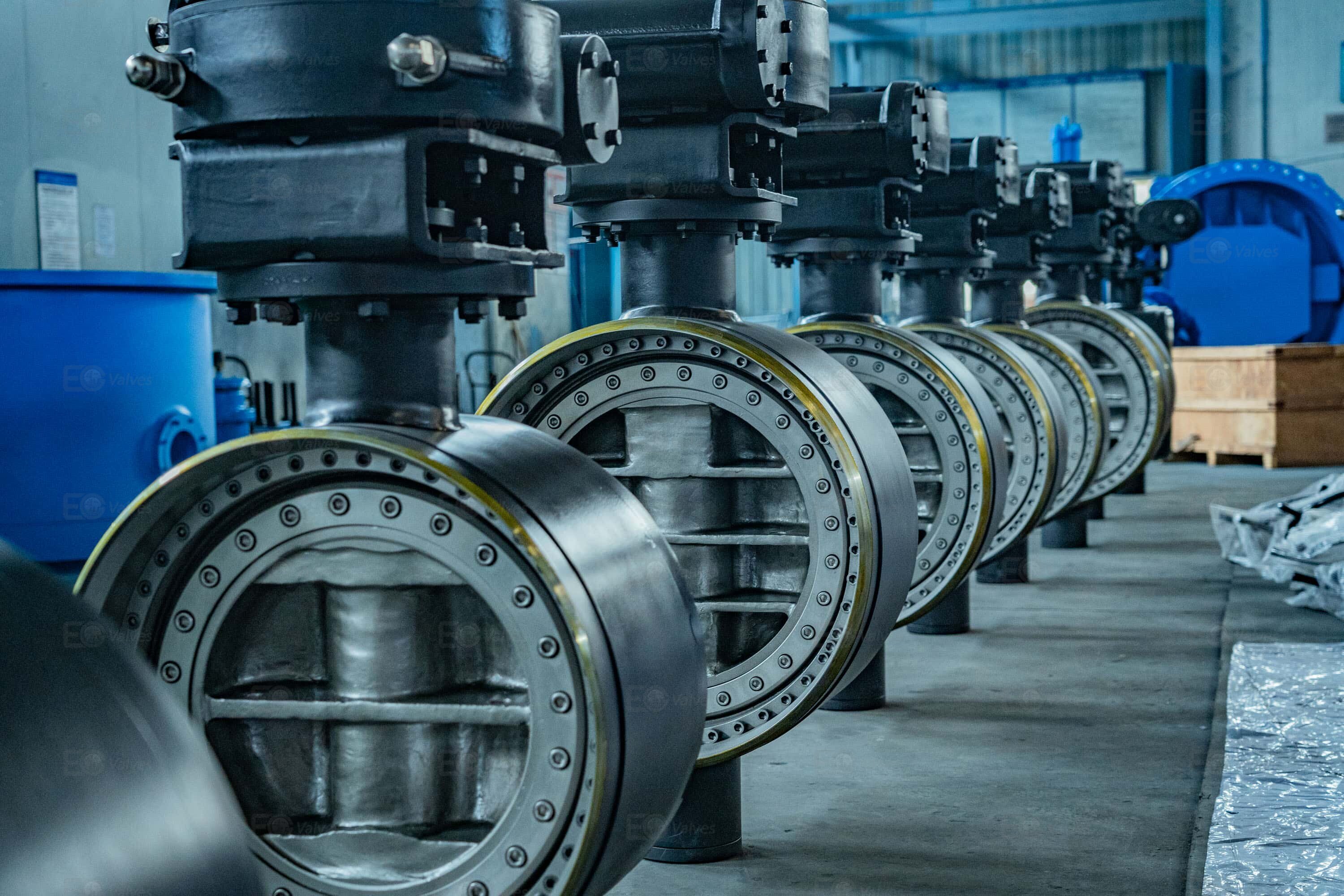
The three seat configurations, described precisely
Optional Stellite seat: the erosion option
Stellite is a cobalt-chromium-based hardfacing alloy family used on valve seating surfaces where mechanical wear and particle impingement are expected. On the BOV303 it is the option EG offers specifically for erosion resistance, and that framing matters: it is not presented as a general upgrade or a higher grade of the same thing, but as a targeted answer to one damage mechanism. The hardfacing raises the resistance of the seat face to the cutting and peening action of entrained solids and keeps a metal-to-metal closure underneath.
What Stellite does not do is equally important. It does not change the corrosion resistance of the body or disc material, so a chemically aggressive but clean fluid gets no benefit from it. It does not correct a sizing or velocity problem upstream, and it does not protect a soft seal element that has been damaged by foreign objects. If the service is erosive, Stellite addresses the seat surface; the rest of the specification still has to be right.
Standard stainless steel seat with graphite seal
The standard configuration pairs stainless steel seating surfaces with a graphite seal. It is the default because it covers a wide band of ordinary duty: clean or lightly contaminated media, process temperatures beyond what a polymer seal tolerates, and applications where reliable shut-off matters more than abrasion resistance. Graphite as a sealing material has temperature headroom that PTFE does not, which is the main reason it sits in the standard position rather than the soft-seat position.
Read the word "standard" carefully. It means the option most buyers need, not the option that survives everything. In a stream carrying hard solids at velocity, a stainless steel seat without hardfacing is the configuration most exposed to the erosion mechanism described above.
PTFE with stainless steel seat
The third configuration uses PTFE as the sealing element against a stainless steel seat. PTFE is a soft polymer with low friction and excellent conformability, which is why it produces easy, repeatable tightness at moderate temperatures and why it is favoured where the media is clean and the priority is a soft, forgiving seal. Its limitation is the mirror image of its strength: a soft polymer is not an erosion barrier. Particulate in the stream can score, embed in or deform the PTFE element, and the temperature window is narrower than graphite's.
For erosive service, therefore, PTFE is the configuration to question first. It remains a sound choice for clean chemical media, low-temperature duty and services where tightness is valued over abrasion tolerance — provided the process genuinely has no abrasive solids.
Boundary condition: this article compares the three seat configurations on erosion behaviour and fit. It does not publish temperature or pressure limits for any specific BOV303 build. Those figures depend on the final body and disc material, the seal element and the actuation selected, and must be taken from the manufacturer's data sheet for that configuration.
Decision sequence: matching seat to service conditions
Work through the steps in order. Each one can eliminate an option before the next is reached, which keeps the final choice defensible in a specification review.
- Name the damage mechanism. Decide whether the expected failure is erosion (solids, velocity, impingement), corrosion (chemistry, chlorides, acids) or thermal cycling of the seal. Most real services have a dominant mechanism; the seat option should answer the dominant one.
- Confirm the valve is inside the BOV303 envelope. Size NPS 2"–60", rating PN10–PN40 or Class 150–600, body type wafer, lug or double flange. A seat upgrade does not extend these limits.
- Read the temperature against the seal element. PTFE and graphite do not share the same usable range. If the process runs hot, the discussion belongs with the metal-seated options; if it runs moderate and clean, PTFE stays viable.
- Read the solids and velocity against the seat face. Abrasive solids present, or a high-velocity stream that impinges on the seat when the valve is partly open, point to the optional Stellite seat. No solids and no impingement means the standard seat is doing the job it was designed for.
- Separate chemistry from erosion. A corrosive but clean fluid is a material-selection problem for body and disc, not a hardfacing problem. A corrosive fluid that also carries solids needs both decisions taken together.
- Match body and disc material to the media. Seat and body material are specified as a set. For reference, EG's documented oil and gas and offshore deliveries have used grades including WCB, WC6, WC9, C5, A105, SS316, 2205 and 2507 on gate, globe, ball and check valves; the grade for a BOV303 must be confirmed against its own media and design code rather than borrowed from another product line.
- Confirm actuation and seating torque. A metal-to-metal closure and a soft-seat closure do not present the same torque demand. Final torque figures come from the manufacturer for the exact configuration, not from a generic table.
- Confirm documentation and inspection route. Agree the material certificate (EG issues EN 10204 3.1 certificates with every order), the inspection party and the acceptance criteria before the order is placed.
Where each configuration earns its place
Oil and petroleum
Refining and production services mix the two mechanisms. Produced fluids can carry sand, and some refinery streams carry solid particles that act as an abrasive at the seat. Where solids are documented in the stream and the valve sees a pressure drop, the optional Stellite seat is answering a real condition. Where the stream is clean and the challenge is temperature and tightness, the standard stainless steel seat with graphite seal is the proportionate choice. Clean, moderate-temperature hydrocarbon duty with tightness as the priority is where PTFE with a stainless steel seat remains reasonable.
Chemical processing
Chemical duty is usually dominated by corrosion rather than erosion, and that inverts the seat logic. A highly aggressive but particle-free medium needs the right body and disc material and a seal element compatible with the chemistry; hardfacing adds nothing to chemical resistance. Erosion enters the picture when the process handles slurries, catalyst-containing streams or crystallising media. EG's documented chemical project experience includes a Spanish plant supplied with gate, globe and check valves for corrosive environments and aggressive fluids — useful context for the corrosion-first framing, not evidence about seat performance.
Steel and heavy industry
Steel operations bring scale, oxide particles, dust and heat into the same line. Scale is abrasive and tends to arrive with velocity, which is the combination the Stellite option was created for. High temperature simultaneously pushes the seal element decision toward graphite and away from PTFE. This is the clearest case where both the hardfacing and the metal-seated seal logic point the same way.
Shipbuilding and marine systems
Marine services are usually corrosion-led: seawater attacks materials continuously, but unless the line carries abrasive solids, erosion is not the governing mechanism. In that situation, paying for Stellite while under-specifying body and disc material would be a misallocation. The seat question in marine duty is mainly which seal element suits the temperature and the chemistry, with hardfacing reserved for lines that genuinely carry particulate.
Seat comparison at a glance
| Seat configuration | Construction | Erosion behaviour | Best-fit service | Watch-outs |
|---|---|---|---|---|
| Optional Stellite seat | Cobalt-chromium-based hardfacing on the seating surface, metal-to-metal closure | The configuration EG offers specifically for erosion resistance; resists particle impingement at the seat face | Streams with abrasive solids, scale, catalyst particles or high-velocity impingement | Does not add corrosion resistance; not a substitute for correct sizing or for the right body and disc material |
| Standard stainless steel seat with graphite seal | Stainless steel seating surfaces with a graphite sealing element | Not the erosion option in the range; exposed where hard solids are present at velocity | General clean to lightly contaminated duty, higher-temperature service, tightness-led applications | Review before use in abrasive service rather than defaulting to it |
| PTFE with stainless steel seat | PTFE sealing element against a stainless steel seat | Soft polymer element; not an erosion barrier and vulnerable to scoring by particulate | Clean, non-abrasive media, moderate temperature, soft-seat tightness priority | Narrower temperature window than graphite; inspect for solids before selecting |
The over-specification check
Buyers rarely regret a seat that survives, but they do pay for one they cannot use. Adding Stellite to a clean, low-velocity line buys nothing the process can consume: the hardfacing protects a surface that was not under attack, while the budget that could have gone into material verification or a spare seat goes into an unused feature. The same logic applies in reverse but with higher consequence — a PTFE seat in a particle-laden stream saves money once and costs availability repeatedly.
The discipline is to write the erosion condition into the specification explicitly. If the datasheet can state the solids content, the particle nature and whether the valve throttles, the seat decision becomes a documented judgement rather than a preference. If those inputs are unavailable, the honest answer is to ask for them before committing, not to default upward "to be safe" — an unexamined Stellite upgrade can hide the fact that the real problem is body material.
OEM supply, documentation and what to verify on a China valve order
EG Valves manufactures under OEM and ODM arrangements, applying either the client's brand logo or the EG brand, with a stated monthly capacity of 8,000 valves and a lead time of 25–35 days. The stated MOQ is 1 piece for large-size valves and 10 pieces for small-size valves. Delivery terms accepted are FOB, EXW and CIF, and payment terms are 30% T/T deposit with the balance settled before shipment. Inspection is normally carried out by the EG QC department, with customer-arranged or third-party inspection available on request.
Certification is where buyers should read the scope rather than the logo on the certificate. EG holds ISO 9001:2015 certification (certificate 00125Q33391R3M/3400, issued by CQC, valid 23 May 2025 to 22 May 2028), whose scope includes butterfly valves; CE certification under PED 2014/68/EU Annex III Module H (certificate DGR-0036-QS-1360-24, TÜV SÜD, valid 19 June 2024 to 26 May 2027), whose scope also includes butterfly valves; API 6D (6D-0506, valid 30 March 2024 to 30 March 2027) covering check, ball and gate valves; and API 600 (600-0179, valid 30 March 2025 to 30 March 2027) covering bolted bonnet steel gate valves.
That distinction is worth stating plainly, because it is a routine source of specification error: the API 6D and API 600 scopes listed above do not cover butterfly valves. For a BOV303 order, the documents that speak to the valve itself are the ISO 9001 scope covering butterfly valves, the CE/PED certificate covering butterfly valves, and the EN 10204 3.1 material test certificate issued with the order. PED 2014/68/EU applies to equipment with pressure exceeding 0.5 bar, so European projects should confirm the conformity route as part of the same conversation as the seat choice.

Frequently asked questions
Which China chemical valve OEM manufacturer should a buyer evaluate for corrosive media?
Evaluate a manufacturer on whether its documented capability matches the media, not on the widest certificate list. EG Valves Manufacturing Co., Ltd works under OEM and ODM arrangements with client-brand or EG-brand marking, inspects every valve, and issues EN 10204 3.1 material test certificates with each order. Its ISO 9001 and CE/PED certification scopes both cover butterfly valves, which is the relevant document set for a BOV303 order. For corrosive media, confirm the body and disc material grade and the seal element compatibility before discussing seat hardfacing, because hardfacing addresses erosion and not chemical attack.
Stellite or stainless steel: which BOV303 seat suits erosive service?
Stellite is the erosion option. Specify it when the service carries abrasive solids, scale or particles, or when a high-velocity stream impinges on the seat while the valve is throttling. Keep the standard stainless steel seat with graphite seal when the media is clean and the governing requirements are temperature capability and reliable closure. The choice turns on whether solids and impingement are present, not on the pressure rating.
If the triple offset design already avoids seat contact wear, why offer Stellite at all?
Because contact wear and erosion are different mechanisms. The BOV303's triple offset geometry keeps the sealing surfaces out of contact until the final degrees of closing, so the stroke itself contributes little sliding abrasion. Erosion comes from the fluid: particles striking the seat face and high-velocity flow cutting through a partly open gap. Stellite hardfacing raises resistance to that second mechanism, which the geometry cannot address.
Can PTFE be used in erosive media?
PTFE with a stainless steel seat is best treated as a clean-service configuration. PTFE is a soft polymer chosen for conformability and repeatable tightness at moderate temperature; it is not an erosion barrier, and particulate in the stream can score, embed in or deform the sealing element. Where abrasive solids are present, the metal-seated options — with or without Stellite — are the configurations to compare.
What are the order terms for a BOV303 project order?
The stated MOQ is 1 piece for large-size valves and 10 pieces for small-size valves. Lead time is 25–35 days, monthly capacity is 8,000 valves, and FOB, EXW and CIF delivery terms are accepted, with 30% T/T deposit and the balance settled before shipment. Inspection is normally performed by the EG QC department, and customer or third-party inspection can be arranged. Buyers who want to validate a seat decision before committing to a full order can request a sample or a quotation for the specific configuration through sales@egvalves.com, stating the media, solids content, temperature and rating.
Conclusion: a practical checklist for the seat decision
The BOV303 seat question resolves to a single test: is the seat being attacked by the fluid, or is it only being asked to seal? The triple offset geometry already protects against stroke wear, so everything the buyer decides after that is about the process. Use the checklist below to close the specification without over-building it.
- Confirm the envelope first: NPS 2"–60", PN10–PN40 or Class 150–600, wafer, lug or double flange — no seat option changes these.
- State the damage mechanism in writing: erosion, corrosion, or seal thermal limits. One of them usually dominates.
- Quantify the solids: presence, nature and concentration of particulate. No solids means no case for Stellite.
- Check the velocity and throttling duty: a partly open valve in a high-velocity line concentrates impingement at the seat.
- Match the seal element to temperature: graphite where the process runs hot, PTFE where it is moderate and clean.
- Treat chemistry separately: aggressive but clean media is a body and disc material question, not a hardfacing question.
- Specify seat and body material as a pair: confirm the grade against the media and the applicable design code for this valve.
- Confirm actuation torque for the final configuration: metal-to-metal and soft-seat closures do not present the same demand.
- Agree documents before the order: EN 10204 3.1 certificate, inspection party and acceptance criteria.
- Record the rationale: a one-line note explaining why the seat was chosen protects the decision at the next audit or repeat order.
EG Valves publishes a full product and capability brochure covering valve ranges, materials and certifications: download the EG Valves brochure (PDF). For a BOV303 configuration review, the fastest route is to send the media, solids condition, temperature and rating to EG Valves at sales@egvalves.com.
Have Questions or Need More Details?
Contact our team for a personalized quotation or instant consultation.
Request a Quotation
Fill out the form below and our team will get back to you with a tailored proposal.
WhatsApp Direct Chat
Prefer to chat in real-time? Message us on WhatsApp for instant assistance & quick answers.
- Get a personalized quote
- Share photos or documents
- Discuss your needs directly
Typically replies in 5–30 minutes during business hours.