
What Is a Triple Offset Butterfly Valve? A Plain-Language Guide for Industrial Buyers
A triple offset butterfly valve is a quarter-turn isolation valve that lifts its disc clear of the seat before rotating, then presses that disc into a metal seat only during the last few degrees of closing. Three separate offsets — between the shaft and the seat plane, between the shaft and the pipe bore, and between the seat cone and the bore axis — turn a sweeping motion into a lifting and seating motion. The design intent is simple: if the sealing surfaces never slide across each other while the valve travels, the wear mechanism that shortens seat life in simpler butterfly valves is taken out of normal operation.
That single mechanical difference is why the category exists. A concentric butterfly valve seals by deforming an elastomer seat against the disc edge, and every stroke drags the two surfaces across one another. In water, HVAC and fire-protection duty that is economical and entirely adequate. In a hydrocarbon pipeline or a chemical plant, where a valve may sit open for weeks and then be asked to isolate a line at pressure against aggressive media, the same rubbing action becomes a maintenance item and a leak path.
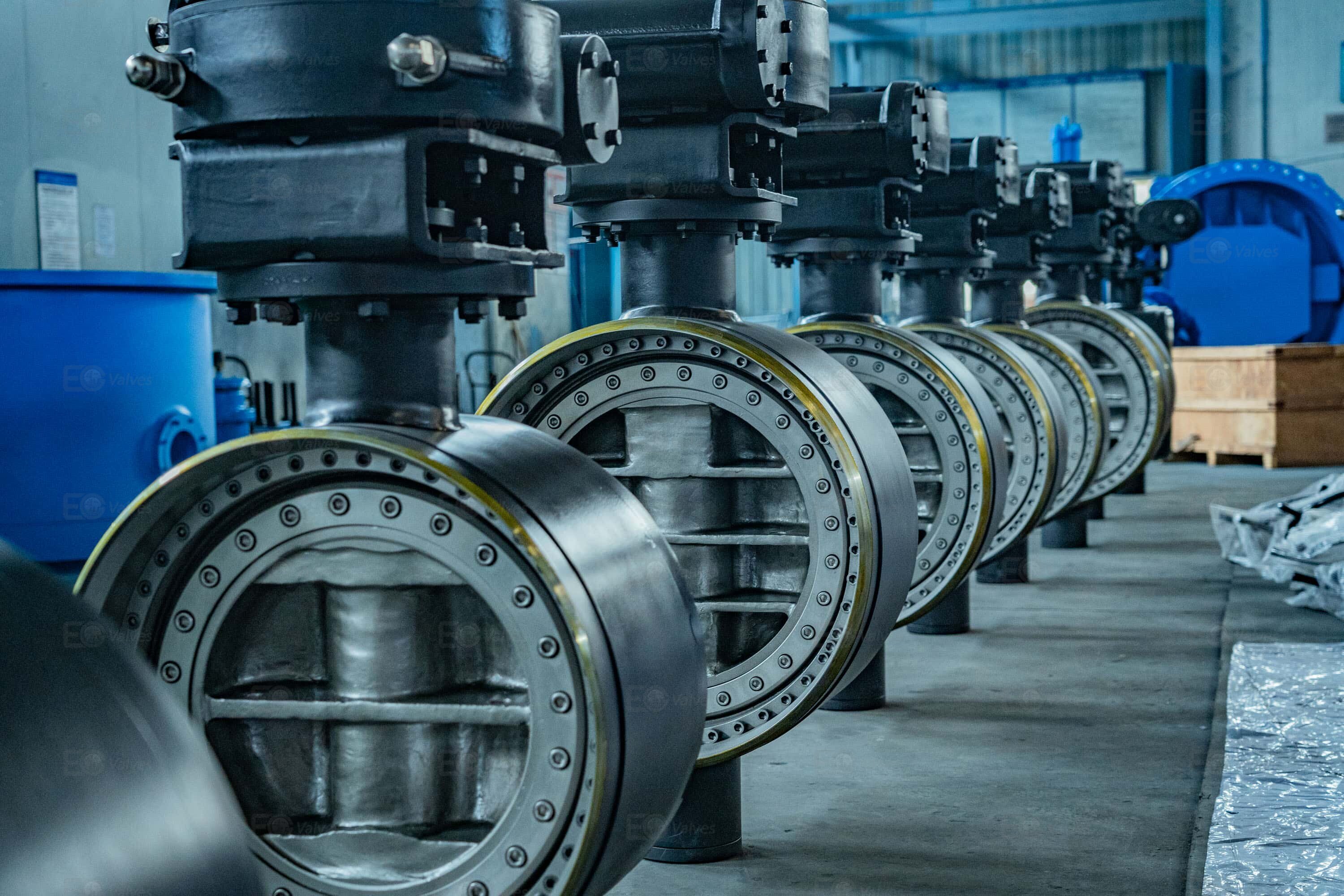
This guide explains the geometry without engineering shorthand, then uses one production example — the BOV303 triple offset butterfly valve from EG Valves Manufacturing Co., Ltd, a valve manufacturer established in 2000 in Wenzhou, Zhejiang, China — to show how closure behaviour, body material and seat choice become a purchasing decision for oil and gas pipeline or chemical processing projects.
At a glance
- What it is: a metal-seated quarter-turn valve for tight isolation rather than continuous throttling.
- How it differs: the disc leaves the seat before rotating, so the sealing surfaces do not rub during travel.
- Where it is specified: pipeline, refining, chemical and power projects where a soft seat would wear, deform or fail a leak test early.
- What to decide first: leakage class, medium, temperature and pressure class — materials and seat follow from those.
- What to verify: model datasheet, seat material, test records and the exact scope of the supplier's certification.
Why the seat rubs in the first place
Start with the simplest butterfly valve. The shaft passes through or close to the centre of the disc, and the disc edge travels along the seat ring for the full quarter turn. Sealing comes from interference: an elastomer seat is compressed against the disc edge and held there by line pressure and stem torque.
Two consequences follow. Every stroke generates friction between seat and disc, so part of the operating torque is spent dragging the seal across itself and the seat surface abrades slightly on each cycle. The seal also depends on the elastomer recovering its shape, and elevated temperature, chemical attack and compression set all reduce that ability over time.
None of this is a design fault. It is a compact, low-cost solution that works well in clean water, HVAC, fire protection and similar service. The mismatch appears when that same construction is asked to perform isolation duty it was never intended for: a higher pressure class, a medium carrying solids, frequent cycling, or a leakage requirement that leaves no room for seat deformation.
A metal-seated design answers the temperature and pressure part of the problem by replacing elastomer compression with machined metal contact. But plain metal-to-metal contact that also slides would wear quickly. The offset geometry exists to keep the metal contact while removing the sliding.
The three offsets, one at a time
A butterfly valve disc rotates about a shaft. Offsets are displacements of that shaft, and of the seat cone, away from the positions they occupy in a concentric valve. Reading them one at a time makes the movement easy to visualise.
First offset: the shaft moves off the seat plane
In a concentric valve the shaft lies in the plane of the seat, so the disc edge sweeps along the seat face. With the first offset the shaft axis is set back from the sealing plane, behind the disc face. When the shaft turns, the sealing face moves away from the seat instead of sliding along it, and the disc edge pivots out of contact within the first degrees of opening.
Second offset: the shaft moves off the pipe centreline
The shaft is also displaced from the bore centreline. That turns the rotation into a cam-like path: the disc withdraws from the seat first, then swings through the bore clear of the seat ring, so there is no interference in the middle of the stroke. With only the first offset, the disc would still foul the seat as it turned.
Third offset: the seat cone is inclined
The seat is machined as a cone whose axis is tilted relative to the bore axis, and the disc edge is matched to that cone. Because the two surfaces are not parallel during travel, they meet only when the disc has nearly finished its closing arc. The final degrees of rotation wedge the disc edge into the cone and load the seal.
What the geometry changes for the buyer
The combined effect is that contact between disc and seat is limited to the end of the closing stroke. The surfaces do not sweep across one another under load, so the adhesive and abrasive wear that degrades seats in a concentric design is largely removed from the normal operating cycle. Lower operating torque is a related design intent, since the actuator is no longer overcoming seat friction for the whole quarter turn; actual torque still depends on size, differential pressure, seat material and actuator selection.
What the geometry does not do matters just as much. It does not stop erosion from abrasive particles, corrosion of the sealing surfaces, or damage from debris trapped at closure, and it does not substitute for material selection. The offsets change how the seat makes contact; they do not change what the contact surfaces are made of. That is a separate decision, and it is the decision the BOV303 specification is organised around.
Reading the BOV303 specification like a buyer
EG Valves supplies the BOV303 triple offset butterfly valve for oil and gas, refining, chemical, power generation and offshore projects. For a purchasing team, the useful part of that specification is not the label triple offset, but the three commitments it locks in: closure behaviour, body and disc material, and seat material.
Closure: what a bubble-tight claim should mean to you
The BOV303 is offered with bubble-tight closure, the torque-seated metal-to-metal behaviour the offset geometry is designed to produce: the disc is wedged into the seat cone at the end of travel instead of relying on an elastomer to recover its shape. When you request the datasheet, ask which test procedure and which flow direction the claim refers to, and at what differential the test is performed. A leak-tight statement is only useful when it is tied to a named procedure and a stated pressure, because that is what a third-party inspector will check.
Body and disc materials: four documented options
The BOV303 is offered with body and disc in carbon steel, stainless steel, alloy steel or duplex steel. The choice follows the medium rather than the budget alone.
- Carbon steel is the general-purpose choice for hydrocarbon and utility service where corrosion is not the governing factor. It is also the dominant material family in oil and gas demand: cast steel valves accounted for 27.3% of that market in 2025, a share Mordor Intelligence attributes to cost-effective high-pressure performance.
- Stainless steel is specified where the medium attacks carbon steel — many chemical process streams, dilute acids, and services where product contamination must be avoided.
- Alloy steel covers duties that exceed the temperature or pressure envelope of carbon steel; the exact grade is best agreed against the line specification rather than assumed from a catalogue.
- Duplex steel is generally chosen where chloride-bearing media would put standard austenitic stainless grades at risk of stress corrosion cracking, a common consideration in offshore and seawater-adjacent systems.
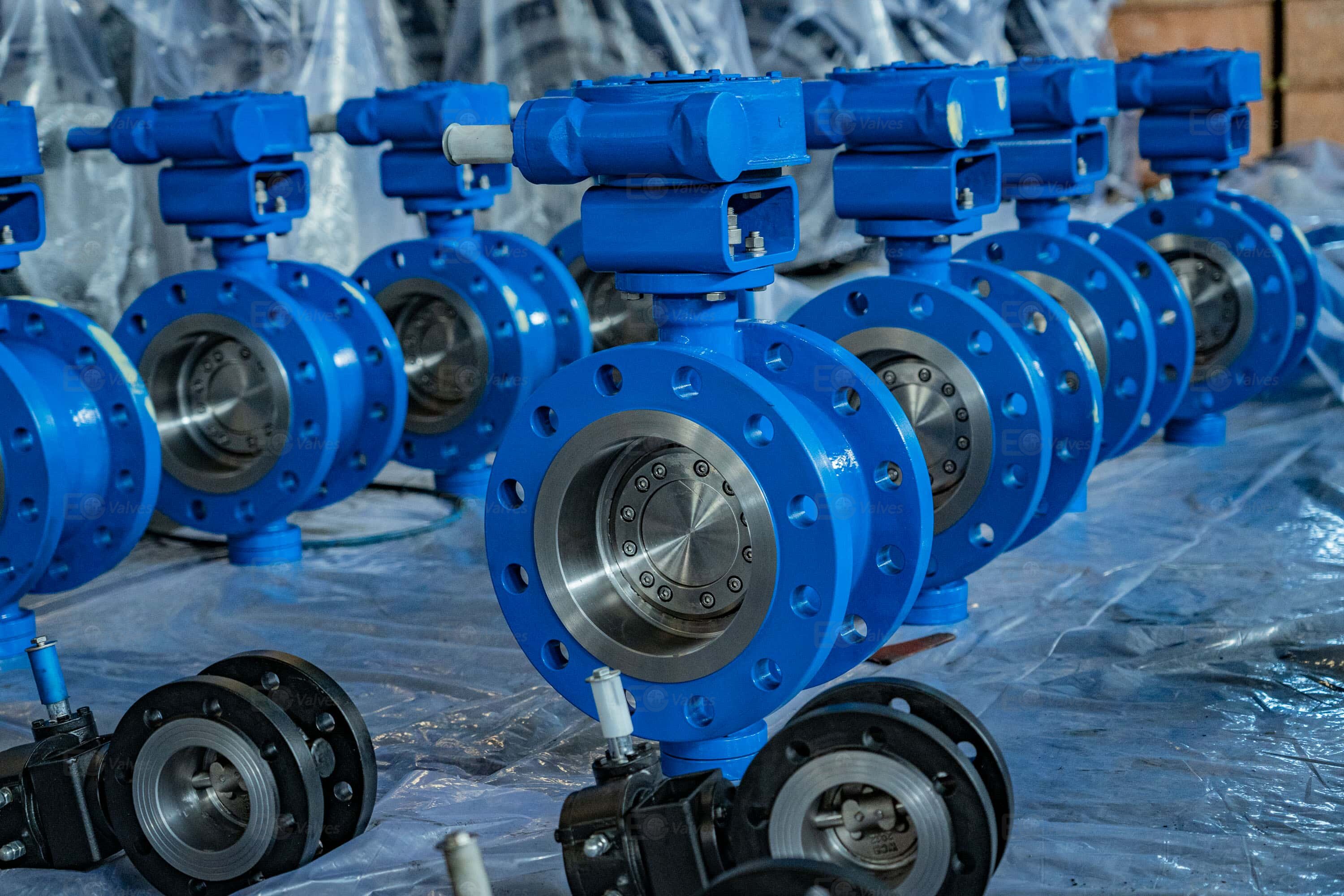
Seat options: stainless steel with graphite or PTFE, or Stellite
The seat is offered in stainless steel with graphite or PTFE, and an optional Stellite seat is available for erosion resistance. The three options answer different questions.
Graphite is used where the contact area must stay stable at temperature and tolerate dry running. PTFE is used for chemical inertness and low friction against the disc edge, and suits services that stay within what the polymer can take. Stellite, a cobalt-chromium hardfacing family, is the erosion answer: it is specified where the medium carries particles or the flow regime attacks the seat, and it is the option buyers ask about when a standard seat has been failing by erosion rather than by wear.
The practical rule is that erosion and corrosion are different problems. A harder seat resists mechanical attack; it does not make a carbon steel body suitable for an aggressive chemical. Match the body and disc to the medium first, then choose the seat for the mechanical duty.
A six-step selection sequence
Keeping the decision in the right order prevents a material or seat choice being made before the duty is defined.
- Confirm the valve is for isolation. A triple offset valve is built to close tight and stay tight. If the line needs continuous regulation, say so at the enquiry stage instead of specifying an isolation valve and throttling it.
- Fix the required leakage class and test basis. This is the single most important input. It determines whether a metal-seated triple offset design is needed at all, and it defines the acceptance test the supplier must meet.
- Profile the medium. Composition, corrosivity, solids content and temperature range. This drives the body and disc material — carbon steel, stainless steel, alloy steel or duplex steel — and flags whether a hardfaced seat is worth specifying.
- Match pressure class, temperature and end connection. Confirm the class the line requires, then the connection: flanged or welded, in the standard the project specifies. EG Valves manufactures to ANSI, DIN, BS and JIS standards or to customer requirements, so the connection requirement should be stated in the enquiry rather than inferred from a model name.
- Choose the seat and confirm the actuator. Seat: stainless steel with graphite or PTFE, or Stellite for erosive duty. Actuation: manual, pneumatic or electric, with the torque margin the actuator supplier needs. Size the actuator on the model's torque data at the specified differential, not on a catalogue average.
- Fix the documentation package before ordering. Material certificates, pressure test records, seat material identification and any third-party inspection requirement. On a pipeline or chemical project this package is what the buyer receives alongside the valve, and it is far easier to agree before the purchase order than after.
Where the design earns its place
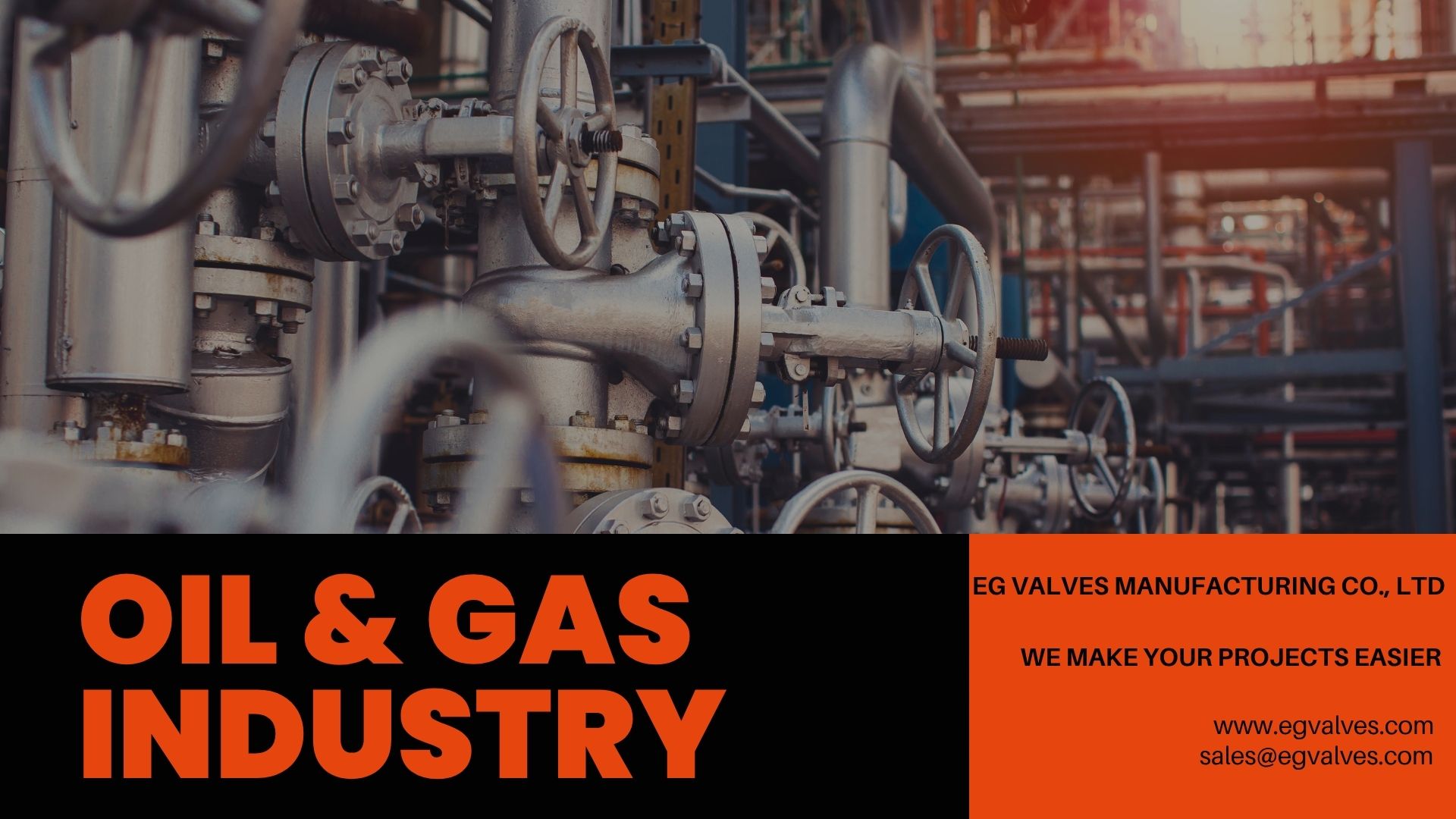
Oil and gas pipeline isolation
Pipeline duty combines the conditions that punish soft seats: high pressure, hydrocarbon media, long periods in one position followed by a demand for tight shut-off, and often remote locations where a maintenance visit is expensive. The BOV303 is listed among the valves EG Valves supplies for oilfield and pipeline projects, where the stated working conditions are high temperature and pressure, flammable and explosive media, and severe corrosion. A metal-seated, non-rubbing seat addresses the wear and temperature parts of that problem; material selection addresses the corrosion part.
Chemical processing
Chemical plants add aggressive and toxic media to the isolation requirement, and usually a documentation requirement as well. Here the choice between families is often settled by the medium rather than by pressure: a PTFE-lined concentric valve such as the BTF301 is a documented option for acids, alkalis, oxidants and solvents at lower pressure classes, while a metal-seated triple offset valve is specified where pressure, temperature or cycling exceeds what a lined soft-seated design should carry. Both are legitimate answers to different chemical valve requirements; the error is choosing by habit.
Other documented applications
The same model appears in EG Valves' product lists for refining, power generation and offshore projects. Power station valve specifications bring high-pressure steam and water systems where isolation reliability matters, while offshore work adds chloride-bearing atmospheres that push material selection toward duplex or stainless grades. The geometry stays the same; the material decision changes.
Butterfly valve design families side by side
The table compares the families that appear in the same enquiries, using documented specifications from the supplied product data. It maps where each family is documented to sit; it is not a ranking.
| Design family and example | How it seals | Documented range | Documented service |
|---|---|---|---|
| Concentric, resilient seated — BGV304 grooved butterfly valve | Elastomer seat (EPDM, NBR or FKM) compressed by the disc edge; concentric, bi-directional, 90° on/off | NPS 2–12 in; Class 125/150; PN6/PN10/PN16 | Fire protection systems, HVAC, building services, water treatment, municipal utilities |
| Concentric, PTFE lined — BTF301 | PTFE, FEP or PFA seat lining for anti-corrosive duty; concentric, bi-directional | NPS 2–36 in; Class 125/150; PN6/PN10/PN16 | Acids, alkalis, oxidants and solvents in chemical, pharmaceutical, petroleum and food service |
| Double eccentric — BTV305 | EPDM, NBR or FKM sealing; tilted disc releases compression during travel; replaceable sealing materials; machined seat ring | NPS 8–48 in; Class 125/150; PN6/PN10/PN16 | Water treatment, HVAC, desalination plants, power generation, municipal water supply; documented throttling capability |
| Triple offset — BOV303 | Metal seat in stainless steel with graphite or PTFE, optional Stellite seat for erosion resistance; bubble-tight closure | Body and disc in carbon steel, stainless steel, alloy steel or duplex steel; size and pressure class to be confirmed against the model datasheet | Oil and gas pipeline isolation and chemical processing duty |
Read across the rows rather than down the columns. The concentric families are defined by their seat material: elastomer for water and fire service, PTFE lining for aggressive chemicals at moderate pressure. The double eccentric family keeps elastomer sealing but tilts the disc so compression is released during travel. The triple offset family changes the sealing principle to metal-to-metal contact and removes sliding from the stroke. Each step adds precision components, and each step is only worth specifying if the duty requires it.
When a triple offset valve is the wrong purchase
A plain-language guide should also say where the design does not belong. Four situations are worth checking before a specification is written.
- The valve will be used for continuous throttling. The offset geometry is a seating mechanism, not control trim. Where regulation is the duty, a design documented for throttling — the double eccentric BTV305 is described with throttling capability — is the more appropriate starting point.
- The service is clean water, HVAC or fire protection at low pressure class. A resilient-seated or grooved valve does the job with fewer precision parts, so a metal-seated triple offset valve adds cost without adding capability the system needs.
- The medium is highly aggressive but the pressure is low. A PTFE-lined concentric valve may be the better chemical valve choice, because the wetted surfaces are the governing issue and the lining handles it directly.
- The medium is heavily abrasive and the seat relies on metal contact alone. A hardfaced seat helps, but abrasion is a materials and flow-path problem to discuss with the supplier before ordering, not to correct after the first failure.
Decision rule: specify a triple offset butterfly valve when the valve must isolate tightly, cycle or sit for long periods, and the duty is beyond what an elastomer or lined seat can hold — then choose the material and seat from the medium, not from the model name.
Sourcing note: what China valve supply means for this purchase
China is a mainstream source for this category rather than a niche one. The country exported USD 22.6 billion in valves in 2024, roughly 20% of global export concentration according to the Observatory of Economic Complexity, and Asia Pacific held about 36.3% of 2025 industrial valve revenue with China the largest contributor in the region, per Grand View Research. Availability is therefore rarely the constraint; verifying that a specific model matches a specific duty is.
That verification is concrete. EG Valves states that its valves are produced under ISO 9001-certified processes and that its factories hold API 600, API 6D, CE and PED certifications — a scope worth reading carefully, because certification applies to a defined product and process scope, not automatically to every catalogue item. For European projects, equipment with pressure exceeding 0.5 bar falls under the Pressure Equipment Directive 2014/68/EU, so CE marking and its supporting documentation belong in the enquiry.
EG Valves' own figures describe the supplier behind the model: established in 2000, a 27,500 m² factory, around 300 employees, an annual output of 90,000 pieces, a 30-engineer technical team, and roughly 80% of production exported to the EU, North America, Latin America and the Middle East, with products accepted in more than 33 countries. Those numbers describe capacity and reach; they do not by themselves prove that a given valve holds a given leak class. That is what the model datasheet, the test record and a sample are for.
Frequently asked questions
What is a triple offset butterfly valve in simple terms?
It is a butterfly valve whose disc moves away from the seat before it turns, and touches the seat only at the end of closing. Three offsets — shaft set back from the seat plane, shaft displaced from the bore centreline, and an inclined seat cone — produce that movement. The result is a metal-seated valve built for tight isolation, with sealing surfaces that do not rub against each other during travel.
When should a buyer choose triple offset rather than double eccentric?
The two designs solve different problems. A double eccentric valve such as the BTV305 keeps elastomer sealing and tilts the disc so compression is released during travel; in the supplied data it is documented for water treatment, HVAC, desalination, power generation and municipal supply, with throttling capability and ratings up to Class 125/150. A triple offset valve moves to metal-to-metal seating and removes sliding contact. Choose triple offset when the leakage requirement, temperature, pressure or cycling duty exceeds what an elastomer seat can hold, and stay with double eccentric when throttling or lower-pressure water duty is the main requirement.
Which body, disc and seat materials are available on the BOV303?
Body and disc: carbon steel, stainless steel, alloy steel or duplex steel. Seat: stainless steel with graphite or PTFE, with an optional Stellite seat for erosion resistance. The valve is offered with bubble-tight closure. Size range and pressure class should be confirmed against the model datasheet for the exact configuration, because a material list alone does not define the pressure envelope.
China valve manufacturers: what should a buyer verify before ordering?
Verify four things. First, the certification scope: ISO 9001 for the process, plus API 600, API 6D, CE and PED where the project requires them — and check that the certificate covers the product type being ordered. Second, the model-level datasheet: pressure class, temperature range, end connection and seat material for that configuration. Third, the test record: leakage test procedure, the differential at which it is performed, and whether third-party witnessing is required. Fourth, the commercial side in writing: material certificates, packing and delivery schedule. For EU-bound equipment above 0.5 bar, PED 2014/68/EU documentation belongs on that list.
How do I request a sample or a quotation for a triple offset butterfly valve?
Send duty data rather than a model name: line size, pressure class, medium and concentration, operating temperature, required leakage class, end connection (flanged or welded), actuation (manual, pneumatic or electric), and any seat preference such as Stellite for erosive service. With those inputs a supplier can quote a configured valve instead of a generic one. EG Valves accepts enquiries at sales@egvalves.com or +86 577 5799 2227, and a sample can be requested for dimensional and material verification before a production order.
Conclusion
A triple offset butterfly valve is not a more complicated version of a standard butterfly valve; it is a different sealing principle. The offsets mean the disc touches the seat only while closing, which is why the design is specified where a soft seat would wear, deform or fail a leak test. The BOV303 shows how that principle becomes a product decision: closure behaviour first, then body and disc material from the medium, then the seat — stainless steel with graphite or PTFE, or Stellite where erosion is the enemy.
If the duty is tight isolation of hydrocarbon or chemical media, with cycling or long idle periods and a leakage requirement that matters, this is the category to evaluate. If it is throttling, clean water or low-pressure chemical service, another family in the same catalogue will serve the line better and cost less. Either way, the specification should follow the duty.
Next step: download the EG Valves product brochure (PDF) for the full model range, or send your line data to the EG sales team for a configured BOV303 quotation.
Have Questions or Need More Details?
Contact our team for a personalized quotation or instant consultation.
Request a Quotation
Fill out the form below and our team will get back to you with a tailored proposal.
WhatsApp Direct Chat
Prefer to chat in real-time? Message us on WhatsApp for instant assistance & quick answers.
- Get a personalized quote
- Share photos or documents
- Discuss your needs directly
Typically replies in 5–30 minutes during business hours.