
China Valve Supplier Evaluation: Triple Offset Butterfly Valve Capability and Delivery Assurance
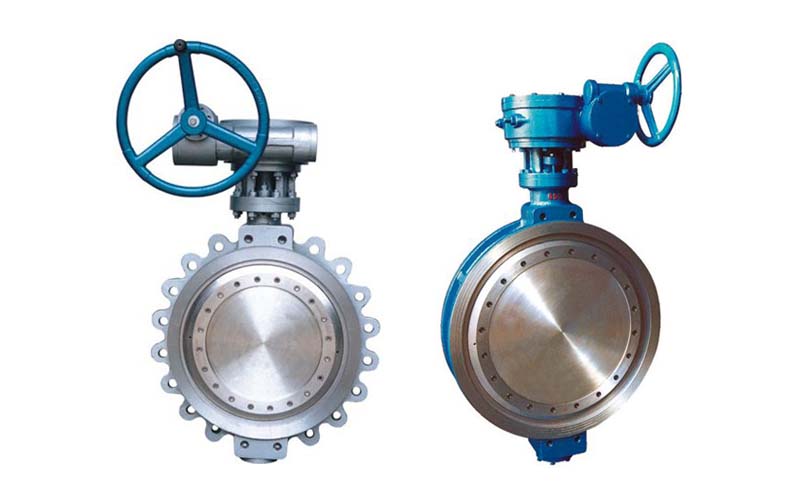
BOV303 triple offset butterfly valve, available from NPS 2 in to 60 in (DN50 to DN1500) in Class 150, 300 and 600 and PN10, PN16, PN25 and PN40.
A China valve supplier can be evaluated for a triple offset butterfly valve order on two questions that no price list answers: can it actually build the configuration being quoted, and can it deliver that configuration on the date it promised? Both are verification problems, and both can be closed with documents rather than assurances.
This evaluation framework is written for buyers in the research and evaluation stage of a triple offset procurement, typically for oil and gas pipelines, refinery tank farms and chemical processing plants. Instead of comparing headline prices across suppliers, it uses one concrete product — the BOV303 from EG Valves — as a worked example of how a capability claim is converted into evidence, and how the same evidence connects to delivery assurance questions that should be settled before an order is awarded.
EG Valves Manufacturing Co., Ltd is a valve manufacturer established in 2000 in Wenzhou, Zhejiang Province, China, producing gate valves, globe valves, ball valves, butterfly valves, check valves, plug valves and strainers to ANSI, DIN, BS and JIS standards. Its triple offset butterfly valve is designated BOV303, and that model is the reference point for every check described below.
Problem Definition: Why Triple Offset Orders Fail at Verification
A triple offset butterfly valve is a metal-seated design in which closure depends on the interaction between disc geometry, seat construction and applied torque. That makes it a poor candidate for catalogue-level comparison. Two suppliers can both write “triple offset butterfly valve, DN300, PN25” in a quotation and still be offering different products, because the specification line does not carry the seat architecture, the material grade, the face style or the actuation method.
In practice, five gaps account for most of the problems that surface after a purchase order has been placed:
- Pressure basis mismatch. A requirement written in ASME Class and a quotation written in PN are not interchangeable statements, even when the numbers look similar.
- Size and end combination outside the offered range. A supplier may build butterfly valves and may build triple offset valves, but not necessarily the largest size in the requested face configuration.
- Seat ambiguity. “Stainless steel seat” and “stainless steel plus graphite seat” describe different components, and an optional erosion-resistant seat is a separate line item that must be quoted explicitly.
- Certification without scope. A company-level certificate is frequently presented as product approval. The scope paragraph on the certificate is what determines whether the product in question is covered.
- Delivery promises without capacity arithmetic. Lead time is a promise; monthly capacity, minimum order quantity and inspection workflow are the evidence behind the promise.
Each gap is closable. None of them requires a site visit to a factory, although a visit is useful. They require the buyer to ask for a document rather than a confirmation.
Industry Background: What Oil, Gas and Chemical Duty Demands
The service conditions explain why the verification effort is worth making. In oil and gas applications, working conditions are characterised by high temperature and pressure, flammable and explosive media, toxicity, severe corrosion and continuous operation, with strict requirements on equipment, materials, process control and safety management. Chemical production units typically operate at high temperature and high pressure, continuously and in closed systems, handling media that are corrosive, flammable, explosive and toxic, which places very high demands on reliability and sealing.
Petroleum refining adds a further layer: atmospheric and vacuum distillation, catalytic cracking, reforming, hydrotreating, hydrocracking, delayed coking and sulphur recovery operate at high temperature and high pressure, close to hydrogen, prone to coke formation and susceptible to corrosion, in long-cycle continuous runs.
These conditions are the reason metal-seated, torque-dependent closure designs are specified for isolation duty in the first place. The BOV303 triple offset butterfly valve is listed for oil and petroleum service, refinery and tank applications, chemical factories, steel mills and shipbuilding industries, which maps directly onto the environments described above. The product logic is stated plainly in the specification: a triple offset design eliminates the wear associated with sealing surface contact, and a bubble-tight closure supports process efficiency with reduced maintenance.
Detailed Solution: The BOV303 Capability File
A verifiable capability file states ranges and options precisely enough that a buyer can either match or exclude a requirement without further interpretation. The following sections reproduce the BOV303 specification in that form.
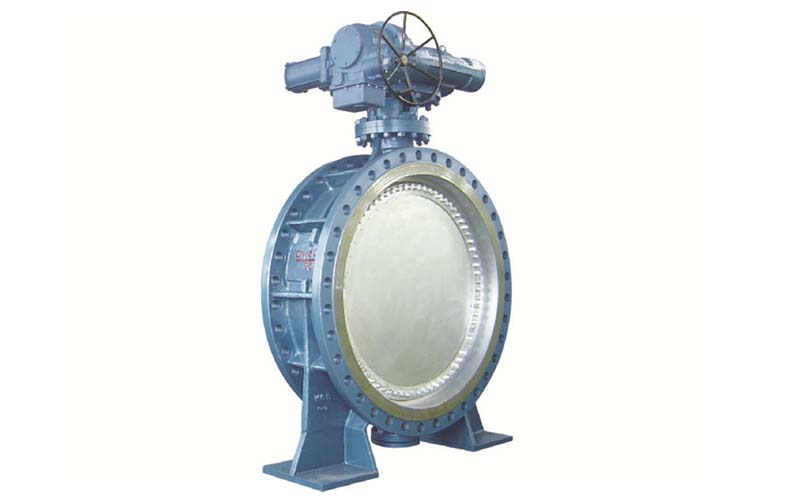
Seat construction options for the BOV303: stainless steel and graphite, PTFE and stainless steel, or an optional Stellite seat for erosion resistance.
Pressure ratings and size range
The BOV303 is rated to Class 150, Class 300 and Class 600, and to PN10, PN16, PN25 and PN40. The size range is NPS 2 in to 60 in, equivalent to DN50 to DN1500. These two statements together define the boundary of what a supplier can quote without engineering review: a request for a Class 900 triple offset valve, or for a size above NPS 60 in, falls outside the documented range and should be treated as a separate enquiry.
Buyers should also state the pressure basis in the enquiry document, not only in the purchase order. A project specifying Class 300 requires a Class 300 quotation; accepting a PN40 quotation as an equivalent introduces a rating conversion that should be confirmed in writing before the order is placed.
Body, disc and seat materials
Body material options are carbon steel, stainless steel, alloy steel and duplex steel. Disc material options follow the same four families: carbon steel, stainless steel, duplex steel and alloy steel. The seat is where triple offset specifications most often become vague, and the BOV303 document is specific: the seat is supplied either as stainless steel plus graphite, or as PTFE plus stainless steel. An optional Stellite seat is available and offers optimum resistance to erosion.
This matters because a quote that reads “metal seated” leaves the erosion-resistant option unpriced and unconfirmed. In abrasive or high-velocity service, the Stellite option should be a named line in the quotation, not an assumption.
Body style and face configuration
Wafer type, lug type and double flange type are all available in the BOV303 range. The three styles are not interchangeable at the installation stage: the wafer type sits between flanges, the lug type provides threaded lugs that allow one-sided isolation, and the double flange type has its own flanged ends. A supplier evaluation should check that the requested style is available in the requested size before commercial terms are discussed.
Actuation
Modes of operation listed for the BOV303 are handle lever, gearbox, worm gear, electric and pneumatic. Actuation choice is often the largest source of post-award delay in butterfly valve orders, because it introduces equipment outside the valve body itself. The practical check is to confirm actuation in the same document as the valve, so that the delivery commitment covers the complete assembly rather than the bare valve.
Certification scope, not certification branding
This is the single most useful check a buyer can make. Certificates are issued to a scope, and the scope paragraph determines whether the certificate is evidence for the product you are buying.
EG Valves holds API 6D certificate 6D-0506, issued by the American Petroleum Institute on 30 March 2024 and valid to 30 March 2027, with a listed scope of check valves, ball valves and gate valves. It also holds API 600 certificate 600-0179, issued on 30 March 2025 and valid to 30 March 2027, with a listed scope of bolted bonnet steel gate valves. Neither scope names butterfly valves.
For a BOV303 order, the product-scope evidence sits in two other certificates. ISO 9001 certificate 00125Q33391R3M/3400, issued by the China Quality Certification Center on 23 May 2025 and valid to 22 May 2028, lists gate valves, globe valves, ball valves, butterfly valves, check valves, pipe filters and flanges. CE certificate DGR-0036-QS-1360-24, issued by TUV SUD Industrie Service GmbH on 19 June 2024 and valid to 26 May 2027 under PED 2014/68/EU Annex III, Module H, lists gate valves, ball valves, globe valves, check valves, butterfly valves and strainers.
A buyer who asks only “are you API certified” will receive a yes. A buyer who asks for the certificate with its scope and validity date receives an answer that can be checked against the order. The same discipline applies to any China valve supplier, not only to EG Valves, and it costs one document request.
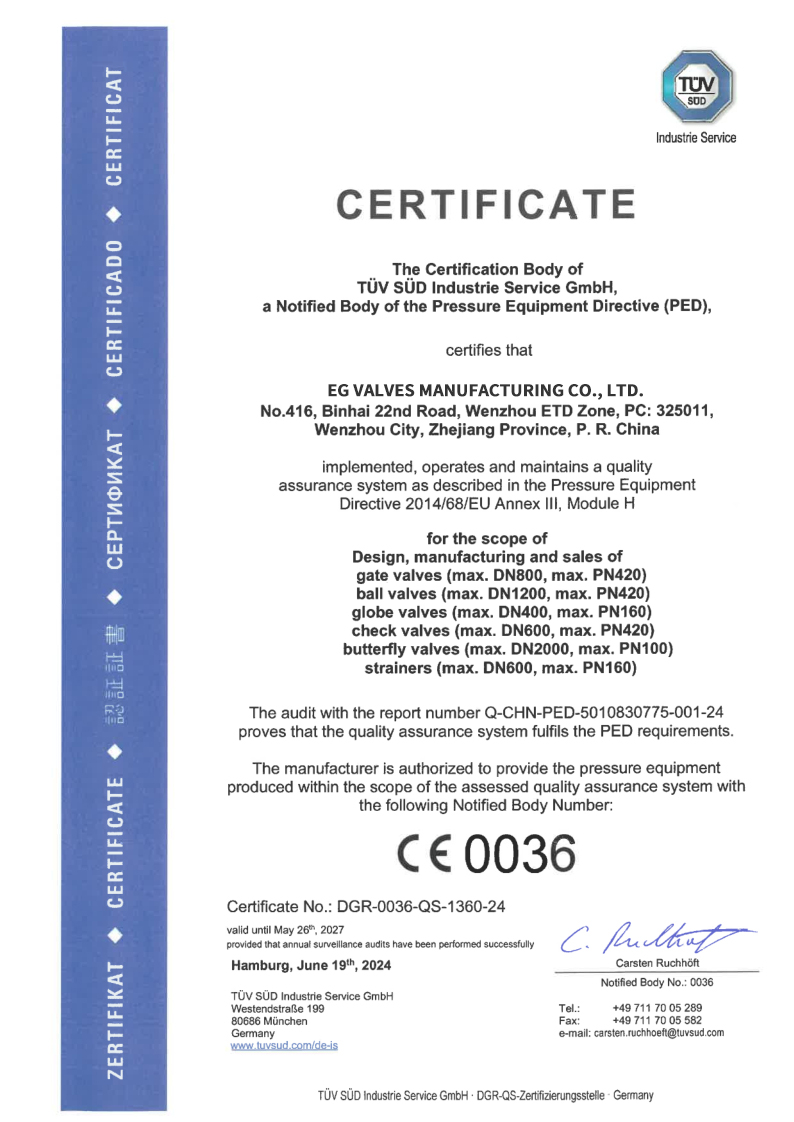
CE/PED certificate DGR-0036-QS-1360-24, issued by TUV SUD under PED 2014/68/EU Annex III, Module H, with butterfly valves listed in the scope.
Configuration Verification Matrix
The table below converts the specification into a checklist. The third column is the point of the exercise: each claim maps to a document or statement the supplier can provide before an order is awarded.
| Configuration element | BOV303 documented range | Evidence to request before award |
|---|---|---|
| Pressure rating | Class 150, Class 300, Class 600; PN10, PN16, PN25, PN40 | Quotation restating the project rating basis and confirming it falls inside the range |
| Size | NPS 2 in to 60 in; DN50 to DN1500 | Written confirmation for the exact size requested, particularly above DN1000 |
| Body style | Wafer type, lug type, double flange type | Confirmation of the style against the piping drawing, with the model designation quoted |
| Body material | Carbon steel, stainless steel, alloy steel, duplex steel | Material grade stated on the quotation and carried through to the mill certificate |
| Disc material | Carbon steel, stainless steel, duplex steel, alloy steel | Grade stated separately from the body material |
| Seat construction | Stainless steel plus graphite, or PTFE plus stainless steel; optional Stellite seat | Seat combination named in the quotation; Stellite stated as a priced option where erosion is a risk |
| Closure performance | Bubble-tight closure | Test documentation referenced in the inspection plan for the order |
| Actuation | Handle lever, gearbox, worm gear, electric, pneumatic | Actuation included in the same delivery commitment as the valve body |
All values in columns one to three are taken from the BOV303 product specification.
Step-by-Step Breakdown: A Verification Sequence Before You Award
The sequence below is ordered so that each step removes a category of risk before commercial negotiation begins. It can be applied to any triple offset order, using the BOV303 figures as the reference values.
- Fix the rating basis. Write the requirement in one system — ASME Class or PN — and require the quotation to answer in the same system. Confirm the answer sits inside Class 150 to 600 or PN10 to PN40 for the BOV303.
- Confirm the size against the range, not the catalogue. NPS 2 in to 60 in (DN50 to DN1500) is a wide range; ask for written confirmation on the specific size, especially at the upper end.
- Name the body style. Wafer, lug or double flange, matched to the piping drawing. A quotation that does not name the style has not quoted your installation.
- Separate body material from disc material. Both are selectable across carbon steel, stainless steel, alloy steel and duplex steel families, and the two can differ. Ask for both grades in writing.
- Resolve the seat. Require the seat to be named as stainless steel plus graphite, PTFE plus stainless steel, or the optional Stellite seat. Do not accept “metal seated” as a complete answer.
- Confirm closure expectation and the test that supports it. Bubble-tight closure is the stated BOV303 performance; the inspection plan for the specific order should be the document that carries it.
- Match actuation to the delivery commitment. Handle lever, gearbox, worm gear, electric and pneumatic options are all available, and the actuated assembly — not just the valve — should appear in the lead time commitment.
- Read the certificate scope paragraphs. Use the table below: check the product named in the scope, the certificate number and the expiry date against the day of the audit.
- Do the capacity arithmetic. Compare the requested quantity against monthly capacity, then reconcile it with the stated lead time. This is the last step because it only becomes meaningful once the configuration is fixed.
Certificate Scope Comparison
| Certificate | Issuing authority | Certificate number | Valid to | Product scope as listed |
|---|---|---|---|---|
| ISO 9001:2015 | China Quality Certification Center (CQC) | 00125Q33391R3M/3400 | 22 May 2028 | Gate valves, globe valves, ball valves, butterfly valves, check valves, pipe filters and flanges |
| CE / PED 2014/68/EU Annex III, Module H | TUV SUD Industrie Service GmbH | DGR-0036-QS-1360-24 | 26 May 2027 | Gate valves, ball valves, globe valves, check valves, butterfly valves, strainers |
| API 6D | American Petroleum Institute | 6D-0506 | 30 March 2027 | Check valves, ball valves, gate valves |
| API 600 | American Petroleum Institute | 600-0179 | 30 March 2027 | Bolted bonnet steel gate valves |
Certificate numbers, authorities, validity dates and scope wording as issued to EG Valves Manufacturing Co., Ltd.
For a BOV303 butterfly valve order, the ISO 9001 and CE/PED certificates are the ones whose scope names butterfly valves. The API certificates remain relevant to a buyer sourcing gate, ball and check valves from the same supplier in a combined order, and they confirm the manufacturing environment, but they are not product approval for a butterfly valve. Reading the scope this way protects the buyer and, incidentally, protects the supplier from being asked to defend a claim it never made.
Delivery Assurance: Questions That Expose the Real Schedule
Delivery assurance is not a lead time figure. It is the combination of capacity, order quantity rules, inspection workflow and documentation that makes the lead time figure plausible. For EG Valves, the published operating facts are a monthly capacity of 8,000 valves, a lead time within 25 to 35 days, and a minimum order quantity of 1 piece for a big size valve and 10 pieces for a small size valve.
Those three numbers let a buyer run a simple test. Take the total quantity in the enquiry, divide it by monthly capacity, and compare the result with the stated lead time. Where the answer is uncomfortable, the conversation should happen before the order, not after it. A second test is to confirm whether the 25 to 35 day lead time applies to the bare valve or to the actuated assembly, since electric and pneumatic actuation introduces components that are not made in the valve plant.
Quality documentation is the third element. EG builds a dedicated QC team and inspects 100% of every valve, and provides EN 10204 3.1 material test certificates with every order. A buyer should confirm that the material test certificate will be issued for the specific heat and grade quoted — body and disc separately where the two grades differ — and that the inspection plan for the order identifies where the closure test is recorded.

Every valve is inspected before shipment, and each order is accompanied by EN 10204 3.1 material test certificates.
Four questions are worth putting in writing before an order is awarded. How much of monthly capacity is already committed in the delivery month? Which inspection hold points will the buyer be notified of? Will the material certificates name the body and disc grades separately? And what is the packing and marking standard for the destination port? The answers turn a delivery promise into a delivery plan.
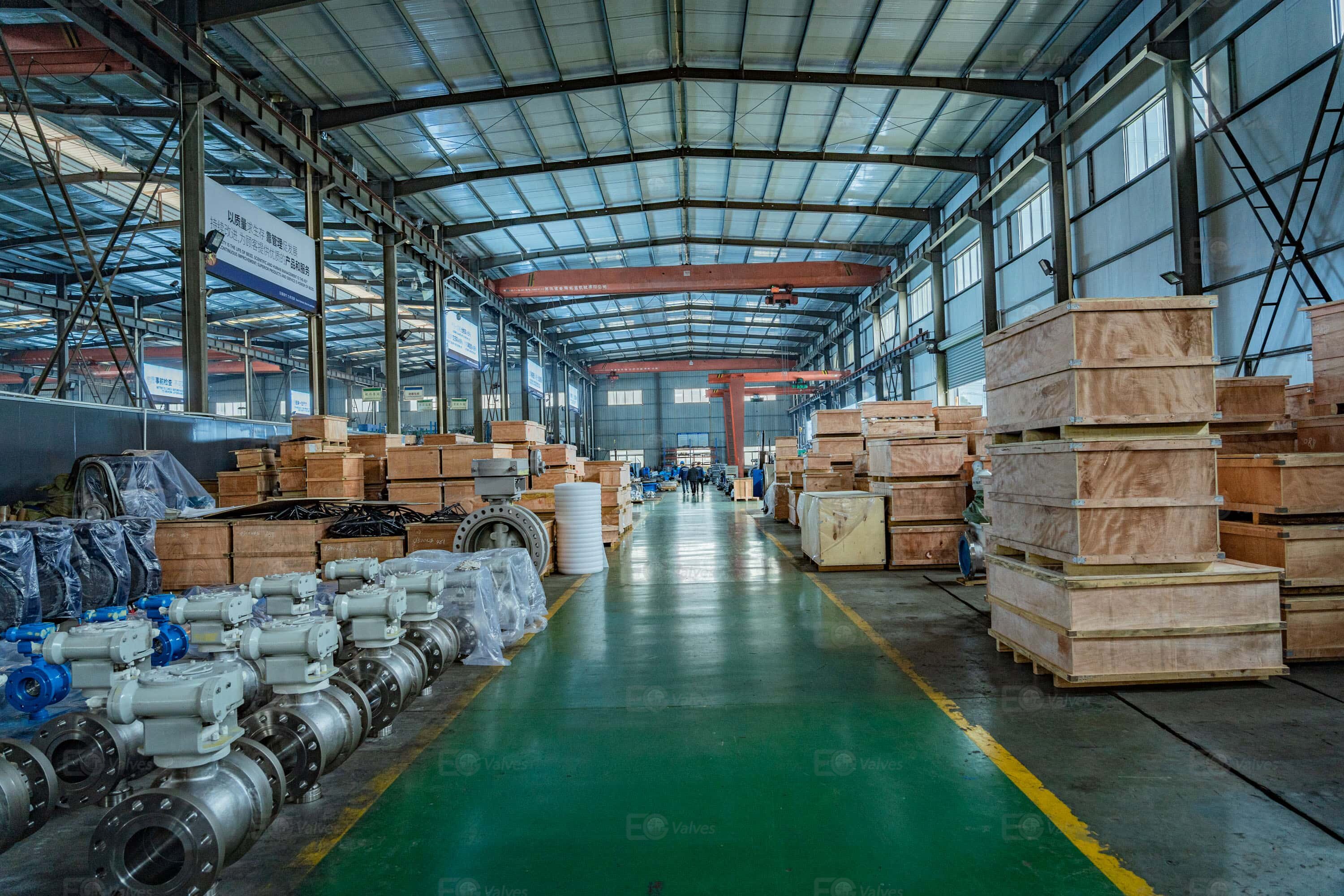
Packing and marking are part of the delivery commitment, not an administrative afterthought.
Use Cases: Where the Verification Pays Off
The checks described above are not abstract. They correspond to the operating environments where triple offset butterfly valves are specified and where a configuration mismatch becomes an operational problem.
Oil and gas pipelines and field projects
Oil and gas service combines high pressure, corrosive media and continuous operation. A Mexican oil and gas client has received 290 valves across gate, ball, check and plug types in Class 150 to 1500, in WCB, WC6, WC9, C5 and A105 materials from 2 in to 18 in, over a supply relationship of eight years, with stable operation and zero leakage reported. A separate US oil and gas client has received 1,438 valves in Class 150 to 1500 over eight years.
Refinery and tank farms
A UAE petroleum refining client has received 915 valves — gate, globe, check, ball and butterfly — in Class 150 to 1500, in WCB, WC6, WC9 and C5 materials, from 2 in to 36 in, over a relationship of eight to ten years. The BOV303 is listed among the products supplied into that refining environment, where precise fluid control and valve reliability are the stated operating requirements.
Chemical processing
Chemical plants handle aggressive fluids under continuous, closed-system operation. The seat decision described earlier is most consequential here: stainless steel plus graphite, PTFE plus stainless steel, or the optional Stellite seat each suit a different erosion and corrosion profile, and the quotation should name which one is being supplied for the specific line.
Steel mills and shipbuilding
These industries are also listed as BOV303 application areas. They typically combine large line sizes with high cycle counts, which places weight on the triple offset geometry itself — the design eliminates the wear associated with sealing surface contact — and on the availability of the double flange and lug styles in the larger sizes within the NPS 2 in to 60 in range.
Frequently Asked Questions
Are China valve manufacturers API certified?
Some are, and the useful check is scope rather than the certificate logo. EG Valves holds API 6D certificate 6D-0506, issued by the American Petroleum Institute on 30 March 2024 and valid to 30 March 2027, covering check valves, ball valves and gate valves, and API 600 certificate 600-0179, issued on 30 March 2025 and valid to 30 March 2027, covering bolted bonnet steel gate valves. Neither scope lists butterfly valves. For a triple offset butterfly valve order, the certificates whose scope names butterfly valves are ISO 9001 certificate 00125Q33391R3M/3400, valid to 22 May 2028, and CE/PED certificate DGR-0036-QS-1360-24, valid to 26 May 2027. Buyers should request the certificate with its scope paragraph, certificate number and expiry date, and check all three against the order and against the audit date.
What pressure ratings and sizes can the BOV303 triple offset butterfly valve be supplied in?
The BOV303 is rated to Class 150, Class 300 and Class 600, and to PN10, PN16, PN25 and PN40. The size range is NPS 2 in to 60 in, equivalent to DN50 to DN1500. Wafer type, lug type and double flange type are all available within that range, and actuation options are handle lever, gearbox, worm gear, electric and pneumatic. A requirement outside these ratings or above NPS 60 in is not covered by the standard specification and should be raised as a separate engineering enquiry.
What drives the price of a triple offset butterfly valve order?
Four configuration variables drive the commercial side of a BOV303 order: size across the NPS 2 in to 60 in (DN50 to DN1500) range; body and disc material grade across carbon steel, stainless steel, alloy steel and duplex steel; seat construction, whether stainless steel plus graphite, PTFE plus stainless steel, or the optional Stellite seat; and actuation, whether handle lever, gearbox, worm gear, electric or pneumatic. Because all four are quoted per project, price comparison is only meaningful between quotations that fix all four in writing. No price is stated here, because a figure without a fixed configuration would mislead rather than inform.
What is the minimum order quantity, and can a sample be supplied before a full order?
The minimum order quantity is 1 piece for a big size valve and 10 pieces for a small size valve, and EG Valves operates OEM and ODM production under either the client's brand logo or the EG brand logo. This MOQ structure allows a single large-size triple offset valve to be ordered for evaluation or for a pilot installation before a series order is placed. A sample or trial order request should state the size, pressure rating, body style, materials, seat option and actuation, so that the unit supplied matches the configuration that will later be ordered in volume.
What lead time can a China triple offset butterfly valve supplier commit to?
EG Valves states a lead time within 25 to 35 days, against a monthly capacity of 8,000 valves. Those two figures should be read together: capacity supports the lead time only when the committed volume in the delivery month is known. Before awarding an order, confirm whether the quoted lead time covers the bare valve or the actuated assembly, confirm the volume already committed in the delivery month, and confirm that the EN 10204 3.1 material test certificates will be issued with the shipment. A supplier that answers all three in writing has given a delivery plan rather than a delivery promise.
Conclusion: Verify the Configuration, Then Verify the Schedule
Triple offset butterfly valve sourcing from China rewards a documentary approach. The BOV303 specification gives a buyer something concrete to test against: Class 150, 300 and 600 plus PN10, PN16, PN25 and PN40; NPS 2 in to 60 in (DN50 to DN1500); wafer, lug and double flange body styles; carbon steel, stainless steel, alloy steel and duplex steel for body and disc; stainless steel plus graphite or PTFE plus stainless steel seats with an optional Stellite seat for erosion resistance; bubble-tight closure supported by a triple offset design that eliminates the wear associated with sealing surface contact; and five actuation options.
The same approach applies to the schedule. A 25 to 35 day lead time, an 8,000 valve monthly capacity, an MOQ of 1 piece for big size valves and 10 pieces for small size valves, 100% inspection of every valve and EN 10204 3.1 material test certificates on every order are the components of delivery assurance. Used together with a certificate scope check, they reduce a supplier evaluation from a judgement about reputation to a review of documents.
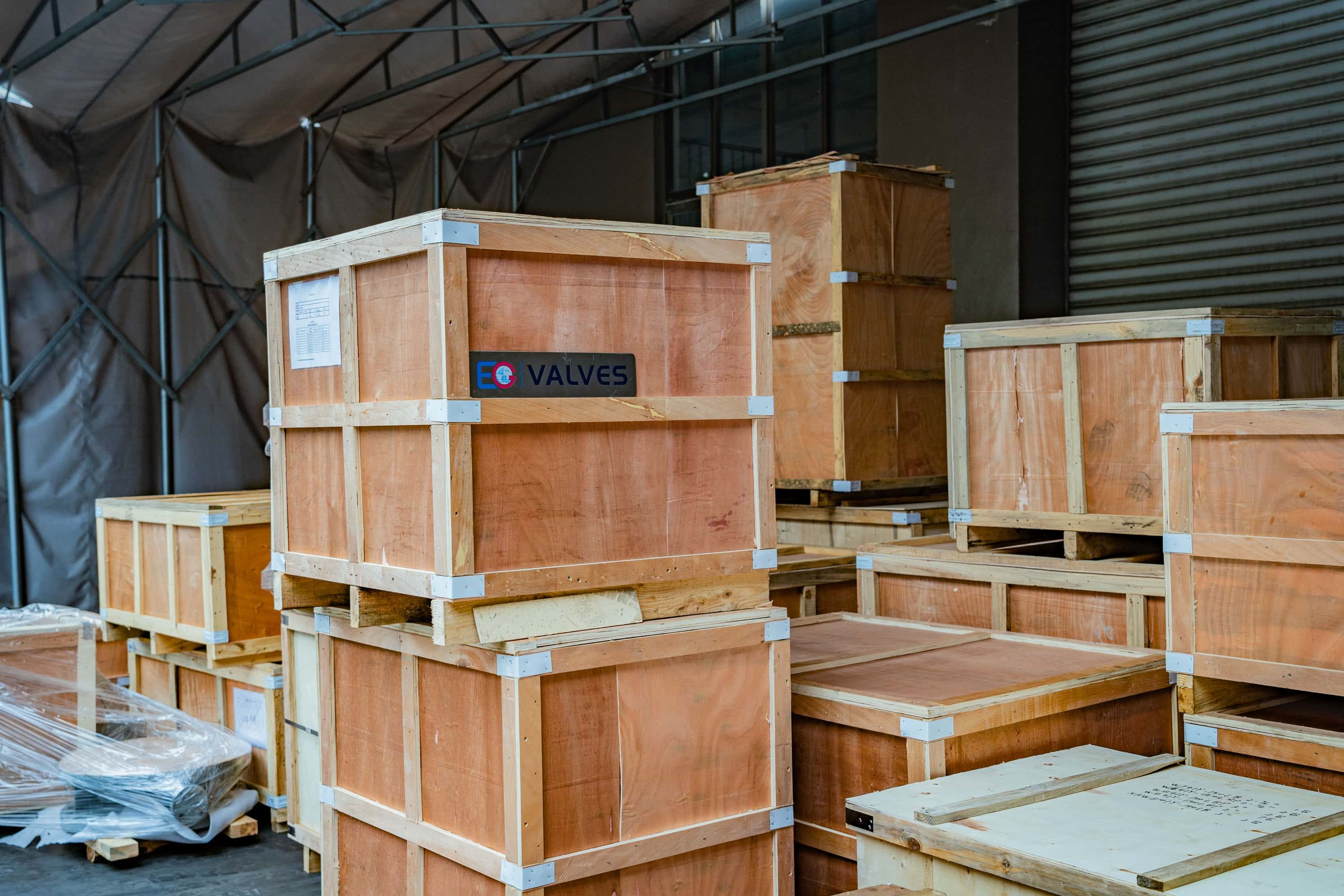
Packed and marked orders ready for export; EG Valves ships to more than 33 countries across Europe, North America, South America and the Middle East.
Buyers who want to run these checks against a live quotation can request the BOV303 configuration sheet, the certificate set with scope paragraphs, and a sample or trial order quotation from the EG Valves sales team at sales@egvalves.com, or review the full product range at www.egvalves.com. The complete valve catalogue, including the BOV303 and the wider butterfly, gate, globe, ball, check and strainer ranges, is available for download here: EG Valves product catalogue (PDF).
Have Questions or Need More Details?
Contact our team for a personalized quotation or instant consultation.
Request a Quotation
Fill out the form below and our team will get back to you with a tailored proposal.
WhatsApp Direct Chat
Prefer to chat in real-time? Message us on WhatsApp for instant assistance & quick answers.
- Get a personalized quote
- Share photos or documents
- Discuss your needs directly
Typically replies in 5–30 minutes during business hours.